
Posted on Leave a comment

Pakistan’s Supreme Court Reinstates Military Trials for Civilians: Implications for Human Rights

Introduction

In a significant legal reversal, Pakistan’s Supreme Court has reinstated the military’s authority to try civilians, overturning its own 2023 decision that had deemed such trials unconstitutional. This move has sparked widespread concern among human rights advocates and legal experts, who view it as a regression in the country’s commitment to civil liberties and judicial independence. The decision revives a controversial law from the era of former military ruler Ayub Khan, raising questions about the future of civilian justice in Pakistan.


Historical Context: The Ayub Khan Era and Military Courts

The reinstated law traces its origins to 1967, during Ayub Khan’s military regime. Under the Defence of Pakistan Ordinance of 1965, civilians could be detained and tried by military courts on vague suspicions of acting against “peaceful conditions.” This framework allowed for preventive detentions without substantial evidence, undermining the principles of due process.

Justice A.R. Cornelius, in the landmark ‘Malik Ghulam Jilani’ case, challenged this approach by asserting that mere suspicion was insufficient for detention. He emphasized the necessity of objective evidence, setting a precedent for protecting individual rights against arbitrary state actions.


The 2023 Verdict: A Step Towards Civil Liberties

In October 2023, the Supreme Court, led by Justices Munib Akhtar and Ayesha Malik, declared the military trials of civilians unconstitutional. The judgment underscored that fundamental rights must be upheld even during times of conflict, aligning with Article 10-A of the Constitution, which guarantees the right to a fair trial and due process.

Justice Malik highlighted the inherent flaws in military court proceedings, noting the lack of transparency, absence of reasoned judgments, and the potential suspension of defense rights under the guise of military necessity. This decision was lauded as a reaffirmation of civilian judicial authority and a move towards strengthening democratic institutions.


The 2025 Reversal: A Judicial U-Turn

On May 7, 2025, the Constitutional Bench of the Supreme Court overturned the 2023 verdict, reinstating the military’s jurisdiction over civilian cases. The bench argued that the Army Act sufficiently protects the right to a fair trial, a claim that contradicts earlier findings about the deficiencies of military courts. Furthermore, the court referred the matter to Parliament to consider legislation granting civilians the right to appeal military court decisions in high courts.

This contradictory stance—asserting that fair trial rights are protected under the Army Act while simultaneously suggesting the need for additional legislative safeguards—has drawn criticism. Legal experts argue that this indicates an acknowledgment of the current system’s incompatibility with fair trial standards.


Implications for Civil-Military Relations and Judicial Independence

The decision to reinstate military trials for civilians has significant implications for Pakistan’s civil-military dynamics and the independence of its judiciary. Critics contend that the judiciary’s deference to military authority undermines civilian oversight and erodes public confidence in the legal system. The involvement of government-nominated judges in the Constitutional Bench further fuels concerns about impartiality and the separation of powers.

This development also raises alarms about the potential for misuse of military courts to suppress dissent and target political opponents, a tactic historically employed during authoritarian regimes. The erosion of civilian judicial authority could lead to a chilling effect on free expression and political activism.


International Human Rights Perspectives

International human rights organizations have consistently criticized the use of military courts to try civilians, citing violations of fair trial guarantees under international law. The United Nations Human Rights Committee has emphasized that military tribunals should not have jurisdiction over civilians, as they often lack the independence and impartiality required for fair proceedings.

Pakistan’s reinstatement of military trials for civilians places it at odds with these international norms and may attract scrutiny from global human rights bodies. Such practices could impact the country’s international standing and its relationships with democratic nations advocating for human rights and the rule of law.


Conclusion

The Supreme Court’s decision to reinstate military trials for civilians marks a pivotal moment in Pakistan’s legal and political landscape. By reviving a law rooted in authoritarian rule, the judiciary has raised concerns about the future of civil liberties and the balance of power between civilian institutions and the military. As Pakistan navigates this complex terrain, the protection of fundamental rights and the independence of the judiciary remain critical to the country’s democratic development.


Posted on Leave a comment

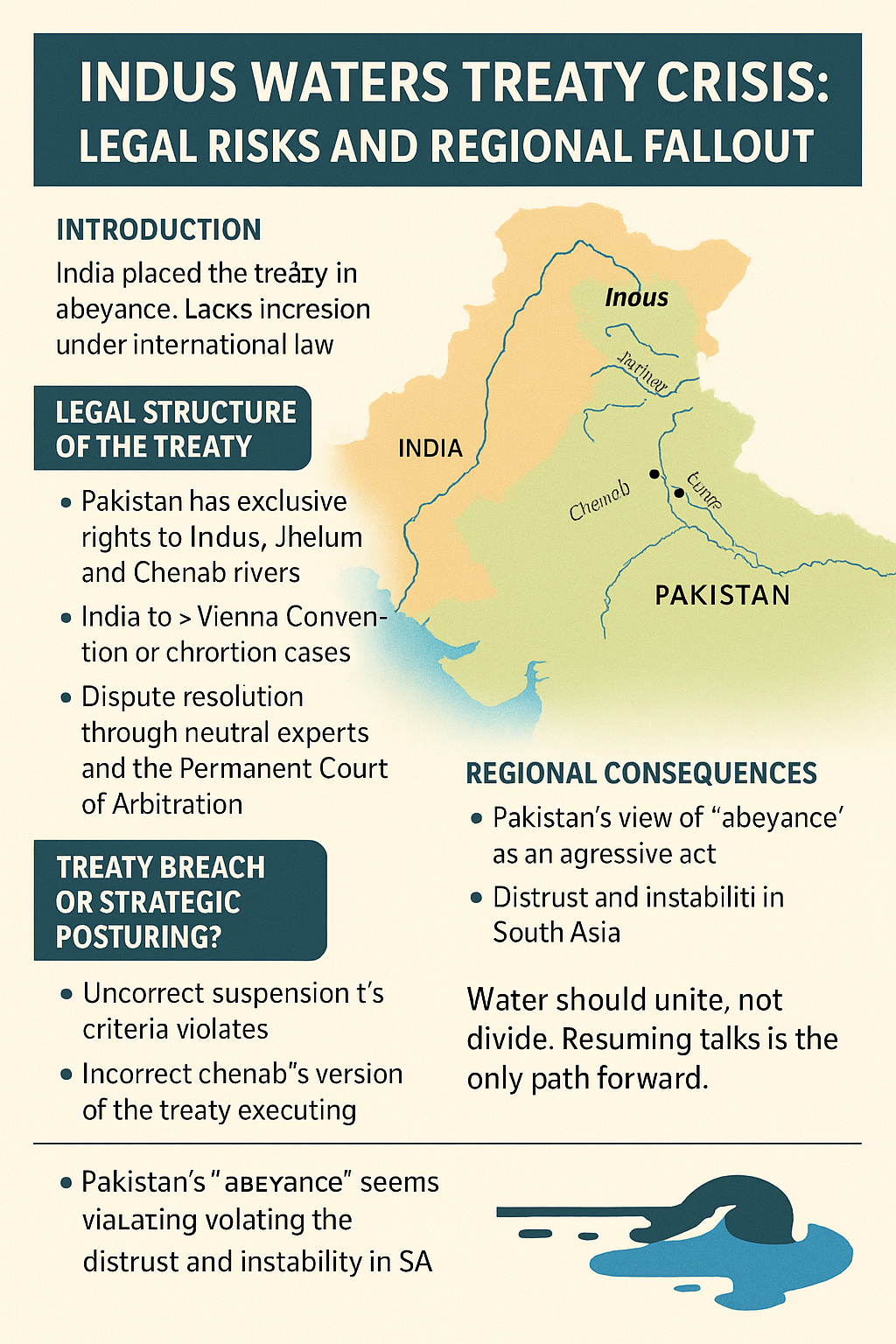
Indus Waters Treaty Crisis: Legal Risks and Regional Fallout


India’s suspension of the Indus Waters Treaty raises legal red flags and regional concerns. Explore its implications under international law and treaty obligations.


Indus Waters Treaty Crisis: Legal Risks and Regional Fallout

For over six decades, the Indus Waters Treaty (IWT) has served as a rare example of cooperation between India and Pakistan in a highly strained bilateral relationship. Signed in 1960 and brokered by the World Bank, it distributed control of six rivers: the eastern three (Ravi, Sutlej, and Beas) to India and the western three (Indus, Jhelum, and Chenab) to Pakistan.

But recent developments have cast a long shadow over this landmark water-sharing agreement. In a drastic move, India has placed the treaty “in abeyance”—a diplomatic phrase that has no clear legal standing under international law.


⚖️ The Legal Structure of the Indus Waters Treaty

Under the IWT:

  • India has exclusive rights over the eastern rivers.
  • Pakistan has unrestricted use of the western rivers, except for limited uses by India (e.g., agriculture, hydropower without storage).
  • The treaty outlines specific rules for dispute resolution, including neutral experts and the Permanent Court of Arbitration.

Suspending a treaty is a legally weighty act. According to the Vienna Convention on the Law of Treaties (VCLT)—the global framework for managing treaties—such suspension is only valid under specific conditions: breach by one party, impossibility of performance, or fundamental change of circumstances.

India’s recent declaration does not meet any of these conditions, making the suspension legally questionable under international law.


🚫 Treaty Breach or Strategic Posturing?

The current standoff follows escalating tensions and border-related clashes between the two nations. By suspending the IWT, India has unilaterally acted outside the treaty’s legal boundaries. According to Article III(2) of the IWT, India must not interfere with the unrestricted flow of the western rivers.

Allegations that India diverted or restricted the Chenab’s water flow could amount to a violation of treaty obligations, constituting an internationally wrongful act that demands remedy or compensation.

Such action not only weakens the legal fabric of the IWT but also sets a dangerous precedent for other transboundary water agreements worldwide.


🧑‍⚖️ What International Law Says

Under international law:

  • Unilateral suspension of a bilateral treaty—especially one like the IWT with well-established mechanisms—is not permitted without formal dispute procedures.
  • The Vienna Convention (1969) governs such treaties and emphasizes resolving conflicts through peaceful means before suspensions or withdrawals.

If India believes the treaty has been materially breached by Pakistan, it should invoke the dispute resolution provisions within the IWT—not act unilaterally.

This action by India could be challenged in the International Court of Justice or be raised at forums such as the UN General Assembly or International Law Commission.


🌍 Regional Consequences: More Than Just Legal Drama

This is not just a legal matter—it’s a geopolitical flashpoint.

Pakistan sees the Indus as its lifeline. Its agriculture, industry, and food security are intricately tied to the rivers controlled under this treaty. Any disruption, especially of the Chenab or Jhelum, could spark major economic and political unrest.

India’s move, even if temporary or symbolic, fuels distrust and instability in a region already burdened by unresolved disputes and competing nationalisms. It also raises fears of “water weaponization”—where access to water becomes a tool of coercion or retaliation.


💬 Missed Opportunity for Diplomacy

What’s even more troubling is that no formal dispute process was initiated before this suspension. The IWT allows for:

  • A neutral expert to resolve technical differences
  • The Permanent Court of Arbitration for legal disputes
  • World Bank facilitation if bilateral efforts fail

By bypassing these steps, India has not only weakened the treaty’s framework but also delegitimized international mechanisms that have long preserved peace over this crucial shared resource.


🛑 A Dangerous Precedent for Water Wars?

The Indo-Pak water conflict is not isolated. Globally, over 260 rivers are shared across national borders, and many nations rely on international agreements to manage access. If large countries can suspend such treaties without legal backing, it undermines decades of diplomacy and environmental cooperation.

Countries like Egypt (Nile), Turkey (Tigris-Euphrates), and China (Brahmaputra) may start taking cues from this bold maneuver—setting off a chain reaction of treaty breakdowns.


✅ Conclusion: Law Over Power

The Indus Waters Treaty has been hailed as a model for cooperation even in the worst of times. If it fails now due to political maneuvering, it will be a failure of law, diplomacy, and foresight.

Pakistan must push for legal redress through international platforms and engage allies diplomatically to exert pressure for treaty reinstatement. India, on the other hand, should recognize the long-term damage to its regional and global credibility if it continues down this path.

💧 In the 21st century, water should be a bridge, not a battleground. It’s time for both nations to return to the negotiation table—not the brink of conflict.


📚 References & Further Reading