Posted on Leave a comment

Indus Waters Treaty Crisis: Legal Risks and Regional Fallout


India’s suspension of the Indus Waters Treaty raises legal red flags and regional concerns. Explore its implications under international law and treaty obligations.


Indus Waters Treaty Crisis: Legal Risks and Regional Fallout

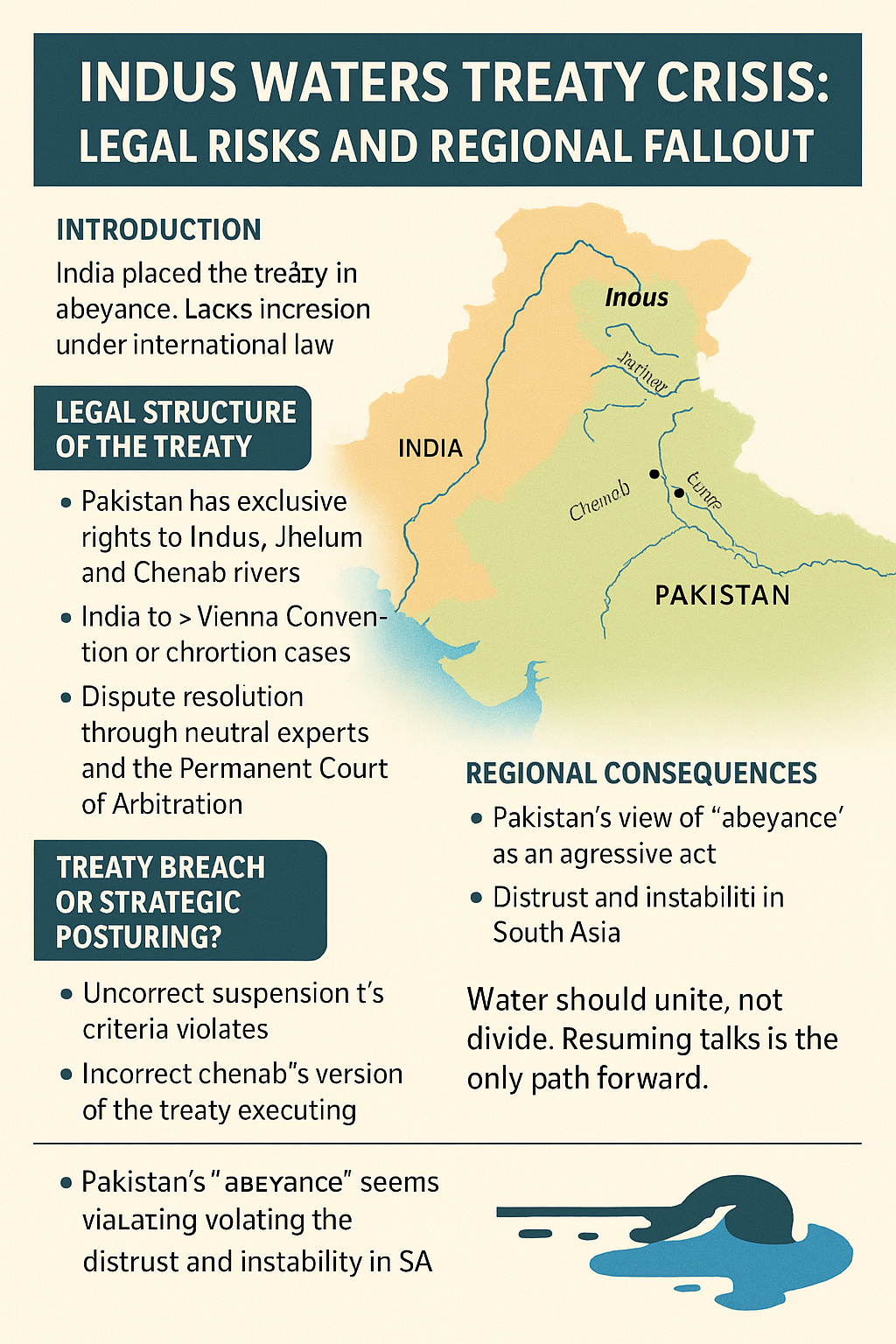
For over six decades, the Indus Waters Treaty (IWT) has served as a rare example of cooperation between India and Pakistan in a highly strained bilateral relationship. Signed in 1960 and brokered by the World Bank, it distributed control of six rivers: the eastern three (Ravi, Sutlej, and Beas) to India and the western three (Indus, Jhelum, and Chenab) to Pakistan.

But recent developments have cast a long shadow over this landmark water-sharing agreement. In a drastic move, India has placed the treaty “in abeyance”—a diplomatic phrase that has no clear legal standing under international law.


⚖️ The Legal Structure of the Indus Waters Treaty

Under the IWT:

  • India has exclusive rights over the eastern rivers.
  • Pakistan has unrestricted use of the western rivers, except for limited uses by India (e.g., agriculture, hydropower without storage).
  • The treaty outlines specific rules for dispute resolution, including neutral experts and the Permanent Court of Arbitration.

Suspending a treaty is a legally weighty act. According to the Vienna Convention on the Law of Treaties (VCLT)—the global framework for managing treaties—such suspension is only valid under specific conditions: breach by one party, impossibility of performance, or fundamental change of circumstances.

India’s recent declaration does not meet any of these conditions, making the suspension legally questionable under international law.


🚫 Treaty Breach or Strategic Posturing?

The current standoff follows escalating tensions and border-related clashes between the two nations. By suspending the IWT, India has unilaterally acted outside the treaty’s legal boundaries. According to Article III(2) of the IWT, India must not interfere with the unrestricted flow of the western rivers.

Allegations that India diverted or restricted the Chenab’s water flow could amount to a violation of treaty obligations, constituting an internationally wrongful act that demands remedy or compensation.

Such action not only weakens the legal fabric of the IWT but also sets a dangerous precedent for other transboundary water agreements worldwide.


🧑‍⚖️ What International Law Says

Under international law:

  • Unilateral suspension of a bilateral treaty—especially one like the IWT with well-established mechanisms—is not permitted without formal dispute procedures.
  • The Vienna Convention (1969) governs such treaties and emphasizes resolving conflicts through peaceful means before suspensions or withdrawals.

If India believes the treaty has been materially breached by Pakistan, it should invoke the dispute resolution provisions within the IWT—not act unilaterally.

This action by India could be challenged in the International Court of Justice or be raised at forums such as the UN General Assembly or International Law Commission.


🌍 Regional Consequences: More Than Just Legal Drama

This is not just a legal matter—it’s a geopolitical flashpoint.

Pakistan sees the Indus as its lifeline. Its agriculture, industry, and food security are intricately tied to the rivers controlled under this treaty. Any disruption, especially of the Chenab or Jhelum, could spark major economic and political unrest.

India’s move, even if temporary or symbolic, fuels distrust and instability in a region already burdened by unresolved disputes and competing nationalisms. It also raises fears of “water weaponization”—where access to water becomes a tool of coercion or retaliation.


💬 Missed Opportunity for Diplomacy

What’s even more troubling is that no formal dispute process was initiated before this suspension. The IWT allows for:

  • A neutral expert to resolve technical differences
  • The Permanent Court of Arbitration for legal disputes
  • World Bank facilitation if bilateral efforts fail

By bypassing these steps, India has not only weakened the treaty’s framework but also delegitimized international mechanisms that have long preserved peace over this crucial shared resource.


🛑 A Dangerous Precedent for Water Wars?

The Indo-Pak water conflict is not isolated. Globally, over 260 rivers are shared across national borders, and many nations rely on international agreements to manage access. If large countries can suspend such treaties without legal backing, it undermines decades of diplomacy and environmental cooperation.

Countries like Egypt (Nile), Turkey (Tigris-Euphrates), and China (Brahmaputra) may start taking cues from this bold maneuver—setting off a chain reaction of treaty breakdowns.


✅ Conclusion: Law Over Power

The Indus Waters Treaty has been hailed as a model for cooperation even in the worst of times. If it fails now due to political maneuvering, it will be a failure of law, diplomacy, and foresight.

Pakistan must push for legal redress through international platforms and engage allies diplomatically to exert pressure for treaty reinstatement. India, on the other hand, should recognize the long-term damage to its regional and global credibility if it continues down this path.

💧 In the 21st century, water should be a bridge, not a battleground. It’s time for both nations to return to the negotiation table—not the brink of conflict.


📚 References & Further Reading


Posted on Leave a comment

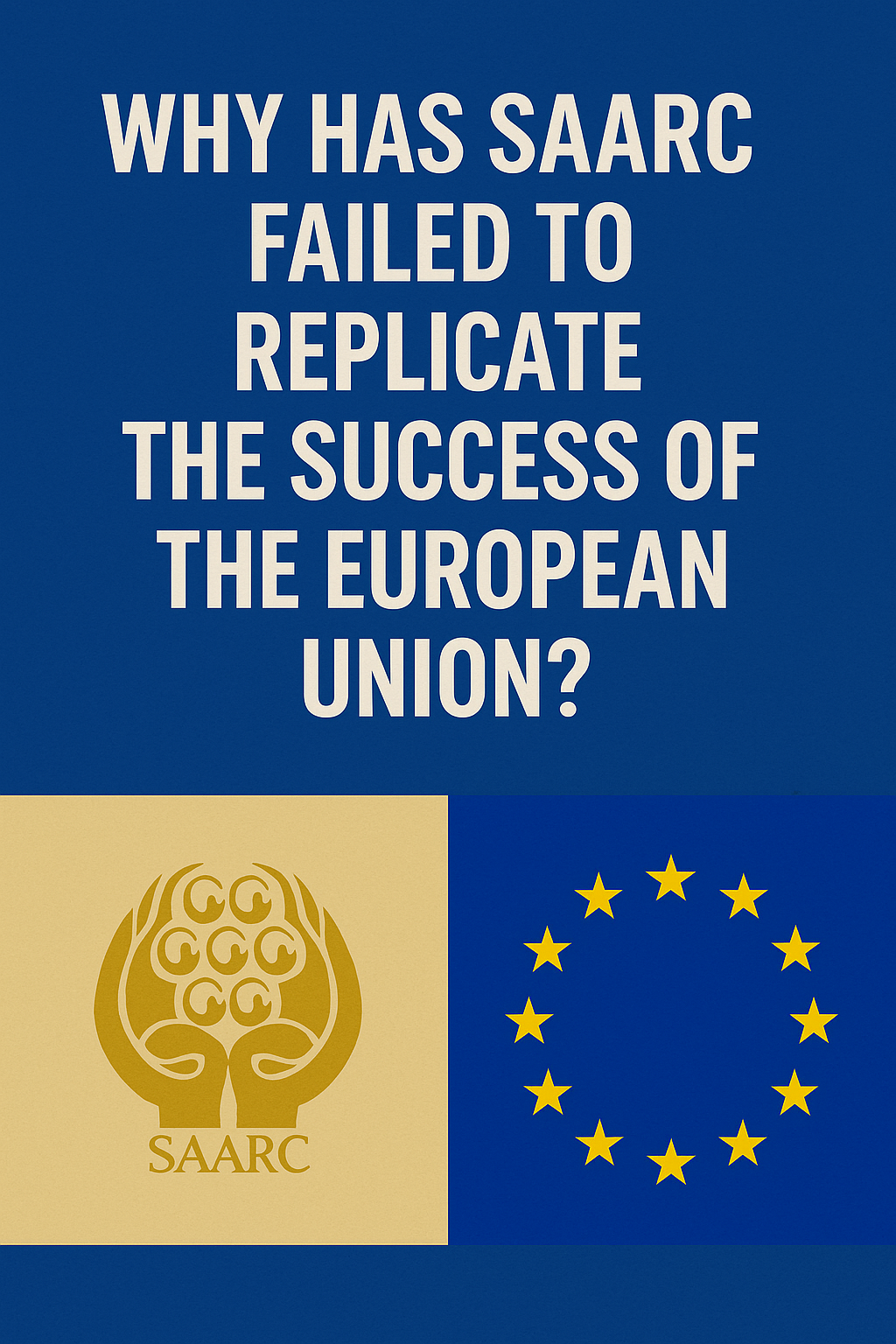
Why Has SAARC Failed to Replicate the Success of the European Union?


Understanding the Gap: Geography Isn’t Enough

At first glance, the South Asian Association for Regional Cooperation (SAARC) seems poised for success. With eight member countries—Afghanistan, Bangladesh, Bhutan, India, Maldives, Nepal, Pakistan, and Sri Lanka—sharing deep-rooted cultural ties, historical connections, and geographical proximity, many expected SAARC to evolve into a powerful regional bloc, similar to the European Union (EU).

However, decades after its inception in 1985, SAARC remains largely ineffective, while the EU stands as a globally admired model of economic, political, and social cooperation.

So, why has SAARC been unable to replicate the EU’s success? Let’s dive into the key reasons and uncover the roadblocks.


1. Political Tensions, Especially Between India and Pakistan

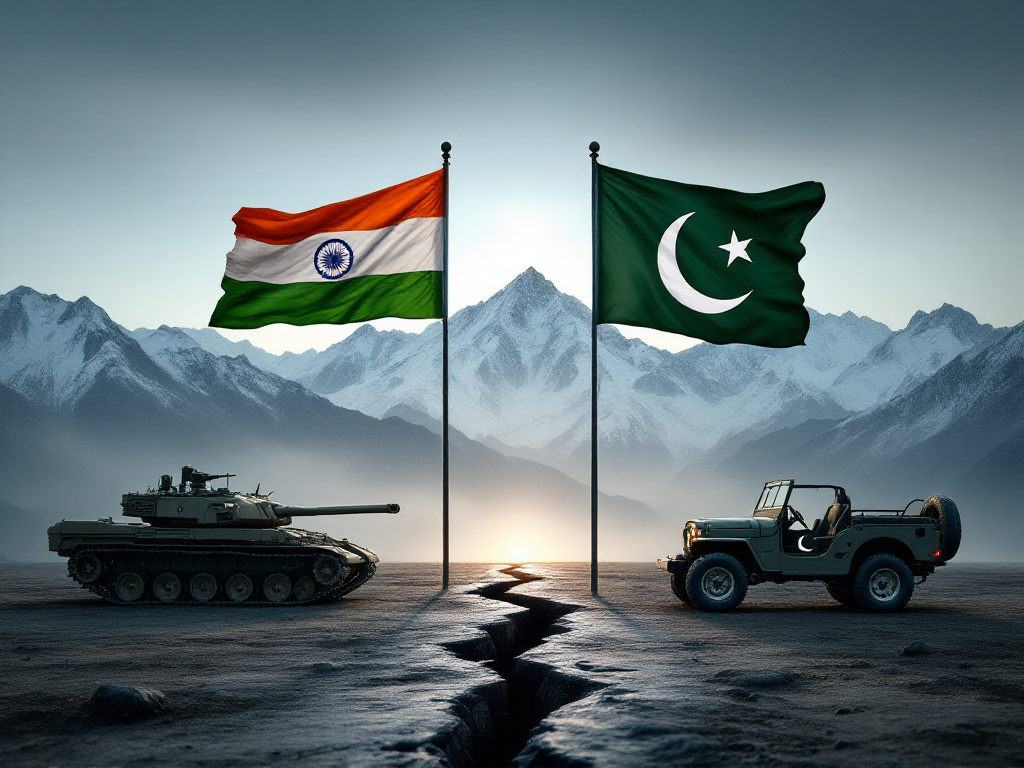
The most significant factor holding back SAARC is deep-rooted political conflicts, particularly the India-Pakistan rivalry. The Kashmir dispute, cross-border terrorism, and military conflicts have overshadowed regional cooperation. Unlike the EU, where countries moved past historical animosities after World War II, SAARC continues to be paralyzed by distrust and blame games.

While the EU promotes open dialogue and consensus, SAARC summits are often delayed or boycotted due to bilateral tensions. This instability has left the organization more symbolic than functional.


2. Lack of a Supranational Body Like the EU Commission

One of the EU’s greatest strengths is its centralized institutions, especially the European Commission, which makes binding decisions and enforces policies. The European Parliament also allows member states to have direct input in decision-making.

In contrast, SAARC operates on strict consensus. Even one country’s objection can stall proposals. This “all or nothing” model leads to policy paralysis. There’s no executive authority or independent body that can drive integration forward or hold member states accountable.


3. Economic Imbalances and Asymmetry in Influence

Another reason for SAARC’s struggles is the economic imbalance among member states. India, the largest and most powerful economy, dominates the region, which breeds mistrust among smaller countries like Nepal, Bhutan, and the Maldives.

In the EU, large economies like Germany and France have played a unifying role, offering support to weaker economies and promoting regional growth. In South Asia, however, India’s neighbors often fear economic dependency and political dominance, which prevents genuine cooperation.


4. Trade Within SAARC Is Minimal

Unlike the EU, where intra-regional trade accounts for over 60% of total trade, SAARC’s internal trade is a mere 5%. Despite the creation of the South Asian Free Trade Area (SAFTA) in 2006, tariffs, bureaucratic red tape, poor logistics, and security concerns hinder trade.

Meanwhile, most SAARC nations trade more with countries outside the region—like China, the USA, and the Middle East—than with their neighbors. This lack of economic interdependence weakens the incentive to cooperate politically.


5. Weak Institutional Framework

The EU was built on a series of legally binding treaties and a solid institutional structure. From the Schengen Agreement to the Eurozone, the EU created common platforms that made cooperation more meaningful and beneficial.

SAARC, on the other hand, lacks legal teeth. It has signed numerous agreements, but implementation remains poor. Without strong institutions, even the best policies become ineffective.


6. Limited People-to-People Interaction

Another pillar of the EU’s success is the freedom of movement. EU citizens can travel, live, work, and study across borders without visas. This has strengthened cultural understanding, economic ties, and a shared identity.

In contrast, SAARC countries have restrictive visa regimes, limited transportation connectivity, and frequent border shutdowns. The average South Asian finds it easier to visit Dubai or London than a neighboring country.

Without greater people-to-people interaction, regional identity and trust cannot flourish.


7. Security-First Mindset Over Development Goals

In the EU, economic and social development are central to regional unity. But in South Asia, security concerns—especially around terrorism, insurgency, and cross-border conflicts—often dominate regional discussions.

Instead of focusing on education, healthcare, climate change, and poverty reduction, SAARC summits frequently collapse into security debates. This focus detracts from long-term regional development.


8. China’s Growing Influence in South Asia

China is not a member of SAARC, but its strategic and economic presence in the region has grown rapidly. Through initiatives like the Belt and Road Initiative (BRI), China has built deep ties with Pakistan, Sri Lanka, Nepal, and the Maldives.

This has created divided loyalties within SAARC, as some members lean towards China while others, like India, remain wary. The result? SAARC struggles to present a unified regional front, further delaying progress.


The Way Forward: Is There Still Hope for SAARC?

Despite its many setbacks, SAARC is not a lost cause. Here are some realistic steps that could help revive the organization:

  • Focus on non-political cooperation areas like climate change, disaster relief, public health, and education.
  • Promote digital connectivity, youth exchanges, and regional startups to build trust among the new generation.
  • Encourage bilateral resolution of political disputes outside SAARC forums to avoid holding the entire bloc hostage.
  • Reform SAARC’s charter to allow majority decisions or a two-tier model for willing countries to integrate faster.
  • Leverage the success of sub-regional initiatives like BBIN (Bangladesh-Bhutan-India-Nepal) as models for integration.

Final Thoughts

SAARC had the potential to become South Asia’s version of the EU. But politics, mistrust, and weak institutions have kept it from becoming a force for regional unity. Geography and culture alone aren’t enough—shared vision, strong leadership, and institutional commitment are the real drivers of successful regional integration.

If SAARC wants to matter in the 21st century, it must evolve beyond its current structure, resolve internal conflicts, and put the needs of the region’s 2 billion people ahead of national rivalries.


Call to Action

🌐 If you’re passionate about global affairs and regional development, subscribe to RemedyTalks for more thought-provoking insights and explainers. Let’s build awareness that leads to action!


Posted on Leave a comment

The Way Forward: A Call for Sustainable Peace in South Asia

Introduction: A Fragile But Vital Opportunity

South Asia has once again arrived at a critical juncture. Following renewed tensions between India and Pakistan, a U.S.-brokered ceasefire agreement has brought temporary calm. But if history is any guide, such truces—while welcome—rarely last without a broader, more inclusive peace framework. The real test lies ahead: Can this be the moment both nations choose dialogue over confrontation?

At the heart of this challenge lies Kashmir, a decades-old dispute that continues to fuel hostility between two nuclear powers. As highlighted in this blog a way forward a long-term solution must go beyond short-term ceasefires and address the roots of regional instability.

Why This Ceasefire Matters

The May 2025 ceasefire comes after a sharp escalation of military hostilities, once again putting the lives of millions at risk. What makes this truce different is the renewed international pressure, particularly from the United States, urging both sides to return to diplomatic channels.

This agreement is not merely a pause in conflict; it is a strategic opening—an opportunity to initiate serious discussions about peace and regional cooperation. For South Asia, peace isn’t a luxury. It’s a necessity.

The Kashmir Dispute: The Heart of the Matter

The Historical Wound

No discussion on South Asian peace is complete without acknowledging the Kashmir dispute—a deeply rooted conflict since the 1947 partition. While numerous attempts at resolution have been made, the situation deteriorated significantly after India revoked Jammu and Kashmir’s semi-autonomous status in August 2019.

This unilateral move by the BJP-led Indian government was seen by Pakistan—and many neutral observers—as a direct attack on the region’s already fragile identity and autonomy.

A Path Forward

The editorial argues that Pakistan remains willing to engage in peaceful dialogue. However, India’s current posture is described as inflexible. Sustainable peace demands that both sides come to the table with equal urgency and open minds.

One potential solution could involve revisiting the Musharraf-Manmohan framework from the early 2000s—a roadmap that emphasized self-governance, demilitarization, and joint supervision. While not perfect, it could serve as a starting point for renewed negotiations.

The Role of Global Powers

Mediation and Moral Pressure

The role of global actors—especially the United States—has proven critical in de-escalating the latest round of tensions. But the question remains: How far will they go?

While no external power can impose a resolution, they can certainly influence the tone and urgency of the dialogue. For example, sustained diplomatic engagement by the U.S., China, or the UN could encourage a more flexible stance from India—something Pakistan has long advocated for.

Out-of-the-Box Solutions

The editorial rightly emphasizes that peace will not come from recycled rhetoric. Instead, what’s needed are “out-of-the-box” solutions that are acceptable to Pakistan, India, and—most importantly—the people of Kashmir. These solutions must include economic development, demilitarization, and political representation.

The Cost of Inaction

Humanitarian Toll

Without a permanent solution, the people of Kashmir will continue to suffer the consequences—curfews, media blackouts, economic marginalization, and human rights abuses. Peace isn’t just about governments; it’s about people.

Economic and Strategic Impact

Continued hostility between Pakistan and India also threatens regional trade, energy projects, and foreign investment. Instead of reaping the benefits of economic cooperation, both countries spend billions on defense—a tragic misuse of resources in regions where poverty and healthcare challenges persist.

The Need for Political Will

Sustainable peace requires more than diplomacy—it requires courage. Political leaders in both countries must demonstrate the maturity and will to move beyond jingoism and prioritize long-term stability over short-term political gain.

Elections come and go, but the impact of conflict lingers for generations. It’s time for statesmanship, not showmanship.

Conclusion: A Regional Imperative

The way forward is not easy, but it is possible. The current ceasefire, while fragile, offers a rare opportunity to redefine South Asia’s trajectory. Both Pakistan and India must recognize that dialogue is not a sign of weakness—it is the cornerstone of civilized governance.

As this blog poignantly argues, any meaningful peace must address Kashmir, engage all stakeholders, and seek innovative, inclusive solutions. The road to peace is not paved with weapons or threats—it’s built on empathy, vision, and negotiation.

Final Thoughts: A Remedy Rooted in Reason

At RemedyTalks, we believe that lasting change begins with honest conversations. The people of South Asia deserve a future free from the shadow of war. Now is the time for leaders on both sides to rise above nationalism and embrace the shared dream of peace and prosperity.

📢 Share Your Voice

  • What’s your take on the current situation?
  • Do you believe a long-term peace deal is possible in our lifetime?
  • Let us know your thoughts in the comments or tag us on social media.