Posted on Leave a comment

Here’s a complete, step-by-step blog-style guideline to help you prepare for the upcoming Punjab Public Service Commission (PPSC) exam for the post of Sub‑Divisional Enforcement Officer (SDEO) under Punjab Enforcement & Regulatory Authority (PERA). If you’re aiming to clear this test, follow these sections carefully and tailor them to your situation in Lahore / Punjab, Pakistan.


1. Understand the Job & Recruitment Context

Before jumping into study mode, it’s important to know what you’re applying for and how the selection process works.

What is SDEO (under PERA)?

  • The SDEO (BS-16) is a regulatory enforcement role within PERA tasked with ensuring compliance with laws and regulations in Punjab.
  • The role is being recruited via the PPSC, so you’ll face the PPSC’s test pattern + PERA’s specific syllabus.
  • Being aware of the job duties helps you align your preparation (for example legal/ regulatory understanding, institutional knowledge, general awareness).

Recruitment & Application Process

  • Keep an eye on the PPSC advertisement (e.g., “Ad No. 33” recently mentioned) for SDEO PERA jobs.
  • Ensure you meet eligibility (education, age, domicile, local quota etc) – check the official advertisement.
  • Download the official syllabus / test day instructions from PERA’s careers page. (pera.punjab.gov.pk)
  • Note test fee, last date, online application steps.
  • After application, test date will be announced; you’ll need to appear in the written exam (and possibly descriptive, interview, etc).

2. Know the Syllabus & Test Pattern

A good preparation plan starts with what you need to cover and how the exam is structured.

Official Syllabus Highlights

According to an uploaded syllabus: (pera.punjab.gov.pk)

  • Legal & General Understanding
    • The Punjab Enforcement & Regulation Act 2024
    • Provisions of Code of Criminal Procedure, 1898 (CrPC) — e.g., Chapters VIII, X, XIII, XIV, XXII.
    • The Constitution of Pakistan, 1973 (Part II, Part VII).
  • General Knowledge & Current Affairs
    • Geography of Punjab; soil/vegetation; agriculture; natural resources. (pera.punjab.gov.pk)
    • Important places, personalities, history (pre- and post-partition) in Punjab.
  • Cultural & Governance History of Punjab
    • Muslim rule, Sikh & Colonial period influence, local government history. (pera.punjab.gov.pk)
  • Basic Maths & Everyday Science
  • English Language Comprehension (synonyms, antonyms, sentence correction etc)
  • Knowledge of ICTs
    • Use of mobile apps, AI platforms, MS Office, digital govt platforms (e.g., domicile management, e-pay). (pera.punjab.gov.pk)

Test-Pattern (based on recent guidance)

  • Many reports show for SDEO PERA 2025: 100 MCQs, no negative marking (though check official ad) (alizajobs.com)
  • Some video/guidance indicate negatives and descriptive papers too: e.g., Paper-I (GK MCQs), Paper-II (English Essay), Paper-III (Law & PERA acts) with possible negative marking (-0.25 for wrong). (YouTube)
  • Key thresholds: candidates must pass each paper (often 40% per paper) and aggregate (often 50%) to qualify. (YouTube)

Bottom line: Check the official advertisement when released. Use the syllabus above to guide your preparation but confirm pattern (papers, time, marks, negative/positive) once the formal notice is out.


3. Preparation Strategy – Step by Step

Here’s how to plan your study time and resources.

Phase 1 – Planning & Resources (Week 1)

  • Get a copy of the official syllabus (save PDF) and highlight each topic.
  • Obtain reliable books / study guides. For PPSC exams, publishers such as Dogar Brothers offer relevant guides. (Dogar Brothers)
  • Collect past papers / sample MCQs for PERA SDEO to familiarize yourself. (TestPoint PK)
  • Create a study timetable: allocate hours daily for each subject.
  • Set SMART goals (e.g., “Finish Constitution topic in 3 days”, “Solve 50 MCQs on ICT by end of week”).

Phase 2 – Foundation & Coverage (Weeks 2-6)

  • Legal & Regulatory Topics: Read the PERA Act 2024, relevant chapters of CrPC, Constitution. Make summary notes.
  • General Knowledge / Punjab: Use a good geography/history book of Punjab. Make maps, timelines.
  • Basic Maths & Everyday Science: Review grade-10/11 level maths & science. Focus on key formulas and concepts.
  • English Comprehension: Practice grammar (synonyms, antonyms, sentence completion). Solve MCQs.
  • ICT Knowledge: Learn about MS Word/Excel/PowerPoint; important gov’t digital apps (e-domicile, e-pay etc); basic AI apps & uses.
  • Each week, include revision blocks (e.g., Sundays) and MCQ practice.

Phase 3 – Practice & Mock Tests (Weeks 7-9)

  • Start doing timed mock exams (100 MCQs) under test-conditions.
  • Use past papers for MCQs and essay practice (if there’s a descriptive paper).
  • Review mistakes: maintain an error log of MCQs you got wrong and understand why.
  • For essay/ descriptive: practice writing essays (e.g., “Role of enforcement agencies in Punjab”, “Digital governance in Punjab”). Focus on structure (introduction, body, conclusion).
  • Improve speed & accuracy: MCQs often require quick reasoning, elimination of wrong options.

Phase 4 – Final Revision & Test Readiness (Last 1-2 Weeks)

  • Revise summary sheets of legal/regulatory topics, GK & ICT.
  • Solve 2-3 full mocks per week.
  • Focus on weak areas (from error log).
  • Ensure you know test day instructions: reporting time, documents, what to bring, what’s prohibited. (See test day instructions PDF) (pera.punjab.gov.pk)
  • Sleep well and maintain health: good diet, exercise, relaxation to keep mind fresh.

4. Tips & Tricks for Success

  • Time-management in exam: For 100 MCQs in 90 minutes (if that’s the pattern) you have less than 1 minute per question — practice under time pressure.
  • Elimination technique: For MCQs, eliminate obviously wrong options first.
  • Keep up with current affairs: Daily news reading (especially Punjab affairs) helps in GK & current affairs section.
  • Map reading & geography: For Punjab geography, brush up on physical features, soil, crops, natural resources.
  • Legal topics – summary style: Don’t try to memorise everything word-by-word. Make concise notes of key points like powers, procedures, important articles/sections.
  • ICT & Apps: Be aware of digital governance initiatives in Punjab (e.g., e-domicile, e-pay) — that can come up.
  • Essay writing: Plan your essay before writing: define structure, key points, use headings if allowed. Keep language clear, avoid long irrelevant stories.
  • Mock exam review: After each mock, spend more time reviewing wrong answers than just solving new ones.
  • Health & mindset: Take short breaks, get enough sleep, avoid last-minute cramming. On test day, reach early, avoid stress.

5. What to do on Test Day

  • Bring required documents (roll-no slip, CNIC and photocopy, required stationery).
  • Arrive early at the test centre to avoid last-minute rush.
  • Read instructions carefully before starting the paper.
  • In MCQ paper: if negative marking applies, be cautious with guessing. If no negative marking, attempt all.
  • Time-check: Don’t spend too long on one question; mark and move on, return later if time allows.
  • Review your answers if time permits.
  • After paper, stay calm. Waiting for results involves interview/psych test (if applicable).
  • Be prepared for further stages (interview, psychological test) if you qualify.

6. Post-Exam: Interview & Follow-Up

  • If you pass written paper, you may be called for psychological assessment or interview (depending on ad). (YouTube)
  • For interview: be ready to answer questions about the job of SDEO, your motivation, current affairs, knowledge of PERA act/regulations.
  • Dress professionally, carry extra copies of your documents and resume.
  • After interview, keep checking PPSC website or PERA portal for result updates.

7. Additional Resources & Books

  • Use recommended guidebooks from reliable publishers (e.g., Dogar Brothers). (Dogar Brothers)
  • Download past MCQ papers and sample papers from sites like TestPoint. (TestPoint PK)
  • YouTube lectures can help for difficult topics (law, ICT, essay writing).
  • Join study-groups or discussion forums (online/gather in person) to share MCQs, notes.

8. Sample Study Timeline (12 weeks)

WeekFocus
1Syllabus review, resource gathering, timetable setup
2Legal/regulatory topics – PERA Act, CrPC overview
3Constitution of Pakistan, rights & procedures
4Punjab geography & history, culture & governance
5Basic maths & everyday science, practice MCQs
6English comprehension, ICT knowledge (MS Office, apps)
7Mock test #1 (MCQs), review errors
8Essay writing practice, advanced legal topics
9Mock test #2 + timed MCQ drills
10Revision of weak areas, current affairs update
11Mock test #3 + final full-length mock under test conditions
12Final revision, mental prep, test-day readiness

9. Common Mistakes to Avoid

  • Ignoring the official syllabus and studying irrelevant topics.
  • Relying only on memorisation without practising MCQs or timed mocks.
  • Neglecting weak spots (e.g., ICT, essay writing) because they seem “easy”.
  • Starting preparation too late. With competitive jobs, early & consistent work is key.
  • Overlooking test-day instructions (reporting time, prohibited items).
  • Ignoring health/mindset — burnout or stress can hamper performance.

10. Final Words of Motivation

Preparing for a competitive job like SDEO under PERA via PPSC is challenging but absolutely achievable with the right strategy, consistency and mindset. Believe in your preparation, stay disciplined, keep revising, and use the time effectively. Every hour you invest now increases your chances of success significantly.



Posted on Leave a comment

Trump’s Iran Strike: The End of Diplomacy in the Middle East?

Donald Trump’s military strikes on Iran mark a dangerous shift in U.S. foreign policy. As diplomacy collapses, tensions soar across the Middle East. What happens next?


Trump’s Iran Strike and the Collapse of Diplomacy in the Middle East

Keywords: Trump Iran strike, US-Iran conflict, Middle East tensions, nuclear diplomacy, Iran nuclear sites, UN Charter violation


🔥 A New War in the Middle East?

Despite repeated claims that he would avoid new wars, former U.S. President Donald Trump authorized a military strike on Iran’s nuclear facilities, dragging the United States into a direct confrontation with Iran—alongside Israel.

Targeting Fordow, Natanz, and Isfahan, the joint U.S.-Israeli operation marks a violation of the UN Charter and plunges the Middle East into dangerous new territory.


⚠️ A Historic First: Nuclear States Attack an NPT Member

This is the first time two nuclear-armed states have attacked a non-nuclear NPT member (Iran). Though diplomacy appeared to be in play days before the attack, the airstrikes exposed those talks as a strategic deception.

Trump claimed a decision was “two weeks away,” but his true intent was revealed through his coordinated actions with Israeli forces. In a televised address, he called the strikes a “spectacular success”, boasting that Iran’s nuclear capabilities were “completely obliterated.”


🇮🇷 Iran Responds: Caution, Not Capitulation

Iran’s Foreign Minister Abbas Araghchi condemned the strike, calling it a flagrant violation of international law. While Iran has vowed to continue its nuclear program, it is expected to halt cooperation with the International Atomic Energy Agency (IAEA) and has demanded an emergency UN Security Council meeting.

The UN Secretary-General António Guterres warned that the conflict risks spinning out of control and poses a direct threat to global peace.


⚔️ Strategic Calculations: Will Iran Retaliate?

So far, Iranian officials report limited damage and no civilian casualties, and much of their nuclear material was reportedly moved in advance. Rather than escalating the conflict, Iran may opt for diplomatic and non-kinetic responses, such as:

  • Closing the Strait of Hormuz (triggering global oil price spikes)
  • Cyber or proxy responses
  • International legal action

However, any retaliatory step could provoke further U.S. strikes, something Iran’s leadership seems keen to avoid—at least for now.


🎲 Trump’s Gamble: A Repeat of Iraq?

This is a high-risk foreign policy move for Trump. With no clear exit strategy, the U.S. could face a repeat of the Iraq war quagmire—a scenario involving endless conflict and rising global opposition.

Trump has signaled he will escalate unless Iran fully surrenders its nuclear program—a condition Tehran has firmly rejected.


💣 Diplomacy Betrayed

Perhaps the biggest casualty in this entire crisis is faith in diplomacy.

Despite engaging Iran in negotiations mediated by Oman and the EU, Trump was simultaneously planning and coordinating military operations with Israel. He later admitted to working with Israeli PM Benjamin Netanyahu in an “unmatched partnership.”

Iran’s Foreign Minister bluntly stated:

“Last week, we were in negotiations with the U.S. when Israel decided to blow up that diplomacy. This week, we held talks with the EU when the U.S. decided to blow up that diplomacy.”


🚨 What Happens Next?

If Iran emerges from this crisis intact, it may very well pursue nuclear weapons capabilities—not out of aggression, but survival. This would mark a historic failure of American and Israeli strategy and could trigger a nuclear arms race in the region.


📌 Conclusion: A Turning Point in U.S. Foreign Policy?

Trump’s actions have not only destabilized the Middle East but also eroded global trust in U.S.-led diplomacy. As tensions soar, and alliances fracture, the question remains: Can peace ever return to the region—or has the world entered a new era of nuclear brinkmanship?


Posted on Leave a comment

From Burnout to Balance: Medical Students’ Mental Health in Crisis

Behind the stethoscopes, white coats, and long hours of study, a troubling crisis unfolds—excessive work hours, unending exams, and immense pressure to excel. While society often views doctors as strong and resilient heroes, more and more future doctors are burning out even before they graduate. The irony is striking: those trained to heal others often suffer in silence themselves.

The Alarming State of Medical Student Mental Health

A landmark meta-analysis published in JAMA revealed that:

  • 27.2% of medical students worldwide experience depressive symptoms
  • 11.1% report suicidal ideation
  • Only 15-20% seek help
  • 50-75% of doctors experience burnout during training 

What Drives Medical Student Burnout?

Burnout is not just “being tired”—it’s a state of emotional exhaustion, depersonalization, and a reduced sense of achievement. Several overlapping factors contribute to this phenomenon:

1. Overwhelming Workload and Academic Pressure

With endless exams, ward duties, packed schedules, and an average of 4-6 hours of sleep, students often feel:

“I feel like I’m constantly running a race I can’t finish,” said one 4th-year student in a BMJ mental health survey (2023).

2. Isolation and Competitive Culture

Many students adopt the belief that struggle is normal in med school and don’t seek support. The competitive environment encourages the fear of being seen as “weak” and prevents students from seeking therapy or taking breaks.

3. Emotional Toll of Clinical Rotations

Clinical rotations expose students to trauma, patient death, medical errors, and ethical dilemmas—without providing sufficient emotional training or support to deal with this stress.

4. Financial Stress & Career Uncertainty

Increasing tuition fees, living expenses, and concerns about future residency opportunities contribute to ongoing stress—particularly in nations such as Pakistan, India, and even the UK.

Voices from the Frontlines: Medical Students Speak Out

“I remember studying for Step 1 while battling panic attacks. I was terrified to tell anyone because I didn’t want to be labeled as ‘unstable.'” – Anonymous M3

“The worst part wasn’t the workload—it was the guilt. If I took a day off, I felt like I was failing.” – Reddit user

These stories highlight a toxic cycle: pressure → burnout → silence → worsening mental health.

Coping Strategies: From Crisis to Care

Fortunately, a shift is starting to occur. Studies now endorse various evidence-based approaches that assist students in coping with stress and avoiding burnout:

1. Mindfulness-Based Stress Reduction (MBSR)

This structured 8-week program teaches meditation and self-awareness, showing immense benefits in reducing anxiety, improving sleep, and even improving academic focus.

A recent 2025 review found mindfulness programs reduced burnout scores by 30-40% among medical students.

2. Peer Support & Mentorship

Programs that connect students with other students or senior mentors should be introduced as they reduce feelings of isolation and create safe spaces for discussion.

3. Curriculum Reforms

Some schools have adopted pass/fail grading systems, mandatory mental health breaks, and reduced working hours, which have seen significant improvements in student well-being.

4. Accessible Campus Counseling

The availability of round-the-clock mental health services and policies allowing students to take leave without penalties are having a significant impact—particularly in European and North American institutions.

5. Address Financial Strains

Reducing tuition fees, forgiving loans and providing financial literacy training can ease economic anxiety.

Healing the Healers

Medical students are the future of healthcare—but how can they care for others if no one cares for them?

It’s time to move from burnout to balance as real change requires systemic shifts—institutional policies that prioritize mental health, a culture that embraces vulnerability, and a training model that values balance as much as knowledge.

We don’t need tougher doctors. We need healthier ones.

Posted on Leave a comment

Israel Launches “Operation Rising Lion”: Major Strike on Iran

Date: June 13, 2025
Platform: Remedytalks.com


🔴 Live Update Summary

  • What happened: Early on June 13, Israel launched airstrikes across Iran—dubbed Operation Rising Lion—targeting nuclear, missile, and military sites in cities including Tehran, Natanz, Khorramabad, and Khondab
  • Notable targets & casualties: The strikes reportedly killed several IRGC commanders—including Major General Hossein Salami—and Iran’s Armed Forces Chief of Staff, Mohammad Bagheri. Nuclear scientists and facilities were also hit
  • Scale & precision: Carried out by the Israeli Air Force and Mossad with dozens of jets and covert operations, Israel described the attack as precise and intelligence-driven
  • Israel’s justification: Prime Minister Netanyahu announced the strikes were preemptive to thwart an imminent Iranian nuclear threat—claims supported by intelligence findings of uranium enrichment nearing weapons‑grade levels
  • U.S. stance: The United States confirmed it was not involved but warned Iran against targeting American interests. Israel had notified U.S. officials beforehand
  • Regional escalation fears: Iran declared national emergency, sealed its airspace, and warned of “bitter and painful” retaliation. International concern is rising as oil markets and global aviation routes respon.

In-Depth Analysis

1. Background

Iran’s uranium enrichment exceeded limits set by the 2015 nuclear deal. The IAEA’s June 12 resolution, the first in two decades, found Iran non-compliant. Tehran quickly expanded enrichment and centrifuge installations, escalating tensions

2. Objectives of Operation Rising Lion

  • Nuclear prevention: To dismantle Iran’s nuclear capabilities before weapons-grade production became irreversible.
  • Targeted elimination: Aimed at IRGC leadership to degrade command structure and strategic capabilities
  • Deterrence: Sent a geopolitical signal to allies and adversaries in the region, resetting the balance of power.

3. Casualties & Damage

Both Sardars and civilians were reportedly killed, including women and children living near hit sites. Residential areas housing military personnel were among the targets .

4. International Reactions

  • United States: Distance maintained; bipartisan voices urged caution to prevent wider conflict.
  • Global leaders: Australia, China, and the EU expressed alarm over escalating violence. Iran sealed its borders and vowed retribution .
  • Oil and aviation impact: Oil prices jumped as airlines rerouted flights, anticipating regional instability .

What Comes Next?

WatchpointDescription
Iran’s retaliationTehran has promised severe response—likely via ballistic missiles or drone attacks. Israeli civil defense has activated nationwide alerts.
U.S. military postureWhile not complicit, Washington is preparing protective measures for assets in the region.
Regional responseGulf states, NATO, and EU are urging de-escalation; Iran may call for renewed sanctions.
Global marketsContinued global market sensitivity anticipated as stability in the Gulf is critical.

📌 Conclusion

Operation Rising Lion marks a historic shift—from proxy skirmishes to direct confrontation. Israel’s bold strike underscores deep fears of a nuclear-capable Iran. The world watches warily as both sides brace for a confrontation that could redraw Middle Eastern geopolitics.

Stay tuned to Remedytalks for ongoing coverage.

Posted on Leave a comment

How U.S. Student Visa Ban Is Hurting the American Economy, Healthcare & Global Reputation


U.S. halts J, M, F visas under Trump—impacting international students, healthcare, and $44B in economic contributions. What does this mean for America?


Introduction: A Silent But Destructive Policy Shift

In a sweeping policy change, U.S. consulates worldwide have been instructed to pause all visa interviews for international students, including J, M, and F visa applicants. This move, made under the Trump administration, is already triggering economic disruption, threatening healthcare staffing, and damaging America’s global reputation as a hub for education and innovation.


📉 The Economic Fallout: $44 Billion at Risk

In the 2023–2024 academic year, international students in the U.S. contributed over $44 billion to the national economy. This includes spending on tuition, housing, travel, and living expenses. International student enrollment supports over 400,000 jobs across various sectors—from education and housing to food and retail.

With the student visa freeze, universities are bracing for a significant drop in enrollment. Many institutions, especially public universities, rely on foreign tuition to fund research, faculty salaries, and student resources. A decline in these numbers could lead to layoffs, program cuts, and diminished academic output.


🎓 Trump vs. Harvard: A Political Power Play

President Donald Trump’s growing hostility toward elite institutions like Harvard University has added fuel to the fire. His administration has criticized Harvard’s large foreign student population—more than 25% of the total student body—and attempted to investigate the school’s admissions policies.

Although a federal judge blocked the administration’s attempt to bar foreign students from attending Harvard, the message is clear: foreigners are being sidelined in favor of domestic political narratives.

This strategy may appease Trump’s voter base, which views Ivy League schools as elitist and exclusionary, but it risks pushing away global talent that helps these institutions thrive.


🏥 A Looming Healthcare Crisis

Foreign Medical Graduates (FMGs) play a vital role in the U.S. healthcare system, particularly in residency programs across underserved areas. Each year, thousands of FMGs are placed in U.S. hospitals, filling crucial gaps in staffing, especially in primary care and rural medicine.

With visa issuance paused, many of these doctors will not be able to start their training, leaving thousands of medical residency slots unfilled. This could cripple healthcare systems already strained from pandemic aftershocks.

It’s a healthcare time bomb—experienced physicians ready to serve, but stuck due to politics.


🌍 A Blow to America’s Global Academic Standing

For decades, the United States has been the global leader in higher education and scientific research. Top students, scientists, and innovators from around the world came to the U.S. not just for degrees but to contribute to groundbreaking research and innovation.

The new visa restrictions now send the opposite message: “You’re not welcome.”

As a result, countries like Canada, the UK, Germany, and Australia are stepping in. They’re offering friendlier immigration policies, scholarships, and research opportunities—poaching the very talent the U.S. used to attract.

This policy risks a brain drain that weakens America’s position in global technology, medicine, and innovation.


🧠 Meritocracy Undermined: The Bigger Picture

Beyond economics and healthcare, the visa freeze threatens America’s core identity as a meritocratic society. When immigration becomes politicized, and visa access depends more on ideology than achievement, the U.S. loses its competitive edge.

Research institutions rely on collaboration, diversity, and international input. Cutting off access to global talent is not just unfair to aspiring students—it’s self-sabotage.


🇺🇸 From Global Leader to Fortress America

What’s especially concerning is the ideological shift. Under Trump’s policies, America is moving from a beacon of intellectual freedom to an isolationist fortress. These decisions aren’t driven by security concerns, but by political ideology aimed at pleasing a narrow domestic base.

This transformation is happening fast—and its consequences may be irreversible if action isn’t taken.


🔚 Conclusion: Who Loses the Most?

In the short term, it’s the international students and medical graduates whose futures are on hold.

In the long term, it’s America that stands to lose the most—economically, culturally, and scientifically.

If the U.S. wants to remain a global leader in innovation, education, and healthcare, it must reverse these restrictive visa policies and return to a path of inclusion and opportunity.


📎 Suggested External References:


Posted on Leave a comment

Pakistan and Crypto: A Risky Romance or Real Opportunity?


Cryptocurrency has captured the imagination of many around the world, and Pakistan is no exception. However, a sort of crypto bug seems to have bitten the government recently — raising eyebrows both domestically and internationally. While some level of interest in crypto is understandable, the line between crypto as a political tool and crypto as a serious business proposition is critical to keep in mind. The stakes are high, because public resources are on the line.


Crypto as Influence Peddling: A Growing Concern

Recent international media reports suggest that part of Pakistan’s government interest in cryptocurrency revolves around gaining influence in Washington DC. Officials close to the Trump administration have been involved in crypto discussions with Pakistani counterparts.

From this perspective, one could say “it is what it is” — governments use emerging trends to build relationships and geopolitical leverage. But this becomes dangerous the moment the government treats crypto as a business or investment avenue rather than a diplomatic tool. The problem is that the resources at risk here are public, taxpayer-funded assets.


The Risk of Gambling with Sovereign Reserves

After the announcement of Pakistan’s Crypto Council, several suggestions have emerged on how Pakistan could expand its crypto involvement. One particularly alarming idea is to allocate a portion of the country’s foreign exchange reserves into cryptocurrencies like Bitcoin.

This suggestion often comes wrapped in a simplistic sales pitch — pointing to Bitcoin’s spectacular rise over the past decade and implying massive potential gains for Pakistan. But what gets conveniently left out is Bitcoin’s extreme volatility.

Sovereign reserves are never gambled on volatile assets. Instead, they are invested in fixed-income, low-risk instruments designed to protect national economic stability. Think pension funds or institutional savings — the rule is always low risk and predictable returns.


Crypto Mining Incentives: Who Benefits?

Another popular proposal is to incentivize crypto mining in Pakistan by offering electricity at rock-bottom prices — as low as 5 to 6 cents per unit. To put that into perspective, residential electricity consumers typically pay around 20 cents per unit, and industrial users about 14 cents.

This raises a critical question: If Pakistan indeed has cheap electricity to spare, why should crypto miners be the first in line to receive it? Why prioritize crypto mining — a speculative, energy-intensive activity — over critical sectors like healthcare, education, or manufacturing?

Adding to the confusion was a recent press release from the Finance Ministry announcing the allocation of 2000MW for crypto mining — without mentioning the price or any clear policy framework. In Pakistan, electricity is not allocated by quotas or sectors in such a rigid manner, so the announcement left more questions than answers.


The Idea of Regulated Crypto Exchanges: A Safer Path?

One proposal that appears less risky is to create on-shore crypto exchanges regulated like commodity exchanges. This step would simply regulate crypto trading, without putting public resources at risk. Regulated trading platforms could provide more transparency and protect investors from scams, but it doesn’t solve the fundamental issue that cryptocurrencies are highly speculative and unstable assets.


The Nature of Crypto: A Fictitious Asset

It is vital to understand that cryptocurrencies are fictitious assets — assets that exist only because holders believe in their value.

Money and gold are also fictitious in nature, but they have widespread acceptance and liquidity. They are trusted to be exchanged for goods and services almost universally. Crypto, on the other hand, remains speculative — driven largely by market hype and speculation rather than intrinsic value.

This speculative nature makes crypto extremely volatile and risky, especially for sovereign investors or public funds entrusted with preserving national wealth.


History’s Lessons: Fictitious Assets and Financial Crises

Fictitious assets are not new. History is littered with examples of how they have destabilized economies:

  • The South Sea Bubble of the 18th century: investments poured into a company with no real business prospects, leading to a massive crash.
  • The Collateralized Debt Obligations (CDOs) crisis in 2008: these complex financial products were essentially bundles of risky mortgages sold as safe assets, sparking the Great Recession.

While regulation has tamed some of these risks, new forms of speculative assets continue to emerge, including crypto.


Why the Government Must Beware

While individual investors may choose to trade cryptocurrencies with their own money, it is highly risky and irresponsible for governments to expose public funds to such volatility. The lure of quick gains can blind decision-makers to the potential fallout of a crypto crash or regulatory clampdown.

Crypto enthusiasts and industry players often market cryptocurrencies aggressively — much like snake oil salesmen — promising huge profits but glossing over the immense risks.


Conclusion: Proceed with Caution

Pakistan’s flirtation with cryptocurrency may offer some diplomatic advantages or potential business opportunities, but it carries significant risks. Public resources are not play money.

The government must differentiate between crypto as a tool for influence and political leverage versus crypto as a serious and sustainable business venture. Investing sovereign reserves or offering cheap electricity incentives without a robust regulatory and risk management framework could jeopardize economic stability.

For now, regulated crypto exchanges seem the safest avenue for Pakistan to engage with the crypto world — balancing innovation with caution.


Posted on Leave a comment

CHINA: INDIA’S REAL-TIME NIGHTMARE AND STRATEGIC DILEMMA

Introduction: The Elephant and the Dragon

India’s geopolitical tension with China has never been a passing storm. It is a simmering, real-time nightmare that defines much of New Delhi’s foreign and defense policy. As Ram Udhav highlights in Uneasy Neighbours (2014), India’s paranoia is neither baseless nor new. It dates back to a prescient warning from Sardar Vallabhbhai Patel to Prime Minister Nehru in 1950: beneath China’s ideological expansion, lurk racial and imperial ambitions.

Fast forward to today, and the fault lines are glaring. From the 1962 war to China’s strategic embrace of Pakistan, India’s vulnerabilities — political, military, and cyber — remain under pressure. China’s expanding technological and military support to Pakistan has forced India into a 21st-century arms race, making its worst fears come true.


Historical Context: Patel’s Warning and Nehru’s Oversight

In 1950, India’s first Home Minister, Sardar Patel, warned Nehru that China’s ideological posturing was a façade for broader imperial ambitions. Patel’s exact words still resonate: “In the guise of ideological expansion lie concealed [China’s] racial, national or historical claims.”

But Nehru, deeply committed to non-alignment and idealistic diplomacy, dismissed Patel’s concerns. He declared “Hindi-Chini bhai-bhai” (Indians and Chinese are brothers), a stance that backfired tragically when Chinese troops swept into Arunachal Pradesh (Zàngnán to China) in 1962. India was caught unprepared, both militarily and politically. The psychological scar of that conflict still looms over Indian strategic thinking.


China-Pakistan Nexus: India’s Two-Front Anxiety

In today’s geopolitical theatre, India faces not just a potential two-front war but a tightly interlocked military axis between China and Pakistan. As Mani Shankar Aiyar aptly put it, the China-Pakistan alliance is “uninterrupted, and uninterruptible.” China has become Pakistan’s all-weather ally. From defense pacts to infrastructure deals like CPEC (China-Pakistan Economic Corridor), the bond runs deep.

India’s concern is not just about the current balance of power but how rapidly Pakistan is absorbing Chinese military technology. There’s growing alarm in Indian intelligence circles that China may supply Pakistan with cutting-edge weaponry — fifth-generation JF-35 fighters, access to its 400 surveillance satellites, and bolstered marine, air, and cyber capabilities.


Pakistan’s Economic Fragility, China’s Strategic Depth

One natural question arises: How can a nearly bankrupt Pakistan afford such upgrades?

The answer lies in strategic subsidization. China’s support for Pakistan mirrors the Soviet Union’s Cold War-era patronage of Cuba. In the 1960s, the USSR paid absurdly high prices for Cuban sugar — not for economic gain, but to maintain a strategic outpost near the U.S.

China is doing the same. It’s not economics, it’s geopolitics. And unlike the U.S. — whose arms deals with Pakistan were conditional and primarily anti-communist — China imposes no such caveats. Their target is clear: India.


Modi’s Nationalism vs Realpolitik

Indian Prime Minister Narendra Modi has framed his political narrative around muscular nationalism. From the Balakot airstrikes to public displays of strength, Modi projects an image of decisive leadership. But critics argue it is more optics than substance.

Yashwant Sinha, a former BJP stalwart, accuses Modi of politicizing national security incidents like Pulwama and Pahalgam to gain electoral mileage. He notes the pattern: tragic events followed by emotional rhetoric, weaponized for votes.

Rahul Gandhi adds another dimension, questioning Modi’s “selective outrage” — asking why his blood boils only in front of cameras, not in closed-door diplomacy.


Global Military Shifts: Learning from NATO and Gaza

While India contends with China and Pakistan, the global military landscape is also shifting. NATO allies are being urged by the U.S. to increase defense spending. The International Institute for Strategic Studies estimates NATO’s rearmament bill at over $340 billion. A vast chunk will go toward naval and air power — paradoxical, given that NATO’s main threat (Russia) is more land-based, as the Ukraine war proves.

Meanwhile, the human cost of war elsewhere — especially in Gaza — serves as a brutal reminder of how military strategies can lose moral ground. Over 50,000 Palestinians have died, with 70% being women and children. Israeli leaders like Moshe Ya’alon and Yair Golan have condemned Prime Minister Netanyahu’s strategy as politically motivated and morally bankrupt.


Religion, Rhetoric, and the Weaponization of Grief

Dr. Alaa al-Najjar’s loss — nine of her ten children in Gaza — echoes ancient laments, evoking biblical sorrow reminiscent of King David mourning Absalom. Her tragedy isn’t just personal; it has become symbolic of the toll authoritarian strategies take on innocent lives.

Back in India, Modi has also used grief as political fuel. During campaign speeches, he claimed his blood now flows with “hot sindoor,” portraying himself as the ultimate nationalist. Yet this theatricality has done little to address the underlying security concerns India faces from China and Pakistan.


Religious Symbolism vs Military Reality

Even the Vatican has tried to weigh in on peace. Pope Leo XIV recently met Ukrainian President Zelensky, hoping to use the Church’s moral influence to end the war. But history reminds us of the limits of such efforts. When advised in the 1930s that Pope Pius XII might object to Soviet religious oppression, Stalin scoffed, “How many divisions has he got?”

Pope Pius responded, “Our divisions are in heaven.” But modern wars aren’t fought with prayers. They’re fought with drones, data, and disinformation.


India’s Strategic Takeaway

India must draw several lessons:

  • China is not just a regional rival; it is a strategic hegemon. It leverages weak states like Pakistan to stretch India thin.
  • Rhetoric is not a substitute for readiness. India needs rapid modernization in cyberwarfare, AI-driven defense systems, and strategic diplomacy.
  • Geopolitical alliances matter. India must strengthen QUAD, fortify ties with ASEAN, and mend strained relationships with neighbors like Nepal and Sri Lanka.
  • Humanitarian integrity is vital. In an age of global media, state brutality — whether in Gaza, Kashmir, or Xinjiang — shapes international legitimacy.

Conclusion: A Time to Wake Up

India’s nightmare with China is not a fantasy. It is an evolving, escalating reality. From military pressure to cyber threats, and from strategic encirclement to information warfare, China has outpaced India in nearly every domain.

New Delhi must now respond not with emotional slogans, but with cold-eyed realism. Patriotism without preparedness is just performance.


Posted on Leave a comment

LAMINE YAMAL SIGNS SIX-YEAR EXTENSION AS BARCELONA EYES FUTURE DOMINANCE


Barcelona, Spain – May 28, 2025

FC Barcelona has officially tied down one of the brightest stars in world football, Lamine Yamal, to a new six-year contract, extending his stay at Camp Nou until 2031. The deal marks a major step in securing the long-term future of the Catalan club as they rebuild under manager Hansi Flick.

Yamal, who first made headlines by debuting for the senior team at just 15 years old in 2023, enjoyed a breakout 2024–25 campaign. At only 17, the Spanish winger was instrumental in helping Barcelona secure a historic domestic treble, including La Liga, the Copa del Rey, and the Spanish Super Cup.

In a season filled with standout performances, Yamal racked up an impressive 18 goals and 25 assists in 55 appearances, making him a key figure in Flick’s high-tempo attacking system. His contributions have drawn comparisons with Lionel Messi, the club’s all-time great, with many hailing him as the most exciting talent to emerge from La Masia in decades.

Barcelona confirmed the contract signing on Tuesday, with President Joan Laporta and Sporting Director Deco present during the official ceremony. The club released a statement calling Yamal’s renewal “a demonstration of the solidity of Barca’s project,” and described his rise as “explosive and historic.”

Yamal’s accolades don’t end at the club level. He has already made 19 appearances for the Spanish national team and was a key player in Spain’s triumph at Euro 2024, where they defeated England 2-1 in a thrilling final held in Berlin.

Since making his debut, Yamal has become the youngest player to score in La Liga, the Copa del Rey, and the Spanish Super Cup, and the youngest ever to reach 100 appearances for Barcelona—a staggering achievement for a player who won’t turn 18 until July.

His growth on and off the field has prompted many to see him not just as a rising star, but as a once-in-a-generation talent. Former players and pundits alike have commented on his maturity, vision, and technical brilliance—qualities that mirror early comparisons to Cristiano Ronaldo’s competitive spirit and Messi’s finesse.

Barcelona has been proactive in its squad development, recently extending the contracts of manager Hansi Flick and Brazilian forward Raphinha. These moves signal the club’s clear intent to return to European dominance, with Yamal poised to be the centerpiece of their new era.

As Barcelona looks to the future, Lamine Yamal’s signature on a long-term deal may prove to be their most valuable win of all.


Posted on Leave a comment

US Still Pakistan’s No. 1 Export Market — But Can We Keep It That Way?

Introduction: A Tense but Pivotal Trade Relationship

Despite rising trade tensions and new US tariffs, America remains Pakistan’s top export destination. In 2024, Pakistan exported $5.4 billion worth of goods to the US, generating a trade surplus of $3.33 billion. But with former President Donald Trump’s return to the global trade stage and his administration’s sweeping reciprocal tariffs on over 60 countries — including Pakistan — the economic equation is changing fast. As a new policy committee forms in Pakistan to chart a response, there’s a clear need to rethink how the country positions itself in an increasingly protectionist trade landscape.

The Tariff Tightrope: High Stakes for Exporters

With a 29% tariff now looming over Pakistani exports to the US, businesses are caught in a bind. Exporters like Interloop CEO Musadaq Zulqarnain warn that while large players may weather the storm due to their deep supply chain relationships, smaller exporters could face severe losses. The profit margins for many have already dropped from 15–20% to around 5–10%. The additional burden of tariffs could make Pakistani goods uncompetitive, especially in price-sensitive markets.

The fear is real: if Bangladesh successfully negotiates tariff relief and Pakistan doesn’t, orders could shift east overnight. The race to absorb costs and retain market share will favor those who can scale, automate, or innovate quickly.

India’s Edge: Negotiating from a Position of Strength

In contrast, India has been given multiple mentions in the US trade fact sheet, underscoring its economic weight and leverage. With a population of 1.3 billion and an active negotiation stance, India may win more favorable tariff terms.

This puts Pakistan in a vulnerable spot. If New Delhi succeeds in securing lower duties, the competitive gap between Indian and Pakistani exports could widen significantly. While Pakistan has longstanding ties with American buyers, especially in the textile sector, reliance on these historical relationships won’t be enough in a fast-changing trade environment.

Inflation in the US: A Hidden Opportunity?

Yet, even amid challenges, there could be a silver lining. With US inflation rising and household budgets tightening, demand for low-priced goods — Pakistan’s specialty — may increase. Mr. Zulqarnain notes that when American consumers cut back, they often downgrade their spending on items like clothing.

For instance, those who once bought branded socks may now prefer cheaper, unbranded alternatives. And those already buying unbranded may stretch their use even further. This shift in consumer behavior could create a window for Pakistan’s budget-friendly exports to gain traction, at least temporarily.

Reimagining the Export Mix: From Cotton to Man-Made Fiber

According to Pakistan Business Council CEO Ehsan Malik, long-term growth will depend on adapting to evolving demand. The global apparel market is shifting toward man-made fiber products, yet Pakistan continues to focus heavily on cotton-based exports.

To remain competitive, the country must retool its export profile. This includes investing in technology, training labor in synthetic textiles, and learning from countries like Sri Lanka and the Philippines. However, security issues and a lack of foreign expert engagement present major barriers to progress.

US Imports: A Tactical Shift That May Not Pay Off

One idea under consideration is increasing imports from the US to offset tariffs and open space for trade negotiations. But the economics don’t quite add up.

Pakistan already imports $772 million worth of cotton from the US, and that too duty-free. With US cotton costing 10–12 cents more per pound than Brazilian alternatives, a shift toward American cotton could raise input costs substantially.

Beyond cotton, there are few American imports that could realistically substitute for cheaper alternatives from China. Soybeans present one opportunity — they carry a 3% duty and could be used for goodwill gestures — but broader import shifts aren’t financially sustainable.

Policy Dilemma: Limited Leverage, High Risks

While the government has formed a policy committee to respond to the trade challenge, its room for maneuver is narrow. Pakistan lacks the geopolitical leverage to retaliate with reciprocal tariffs against the US. Nor can it afford to escalate tensions with one of its few major markets.

The only pragmatic option is to present a credible case to the US that Pakistan’s export-driven economy offers long-term value — and that tariff relief would serve both sides by stabilizing supply chains and maintaining affordability in the US market.

A Narrow Path Forward: Competitiveness Through Strategy

The unfortunate truth is that Pakistan’s fate may hinge more on its competitors’ actions than its own. If India and Bangladesh secure better terms, Pakistan could suffer collateral damage.

However, it’s not all doom and gloom. The recent electricity rate cuts for industrial sectors could lower production costs and rejuvenate large-scale manufacturing. Coupled with rising demand for low-cost goods in an inflation-hit US economy, Pakistan might just find a temporary uplift.

Still, for sustainable growth, Pakistan must act. That means:

  • Reassessing its export composition
  • Investing in synthetic textiles
  • Strengthening labor skills
  • Diversifying export markets
  • Proactively engaging in trade diplomacy

Conclusion: Can Pakistan Hold On to Its Top Export Market?

Pakistan remains deeply reliant on the US as an export market. But global trade is being reshaped, and passive strategies won’t cut it. In a world of reciprocal tariffs and strategic alliances, Pakistan must become proactive, nimble, and forward-thinking.

As discussed in our post on “The Geopolitics of Textile Trade,” sustaining market share in the US will take more than competitive pricing — it will require vision, reform, and courage.

Suggested Internal Link: As discussed in our post on “The Geopolitics of Textile Trade”

Posted on Leave a comment

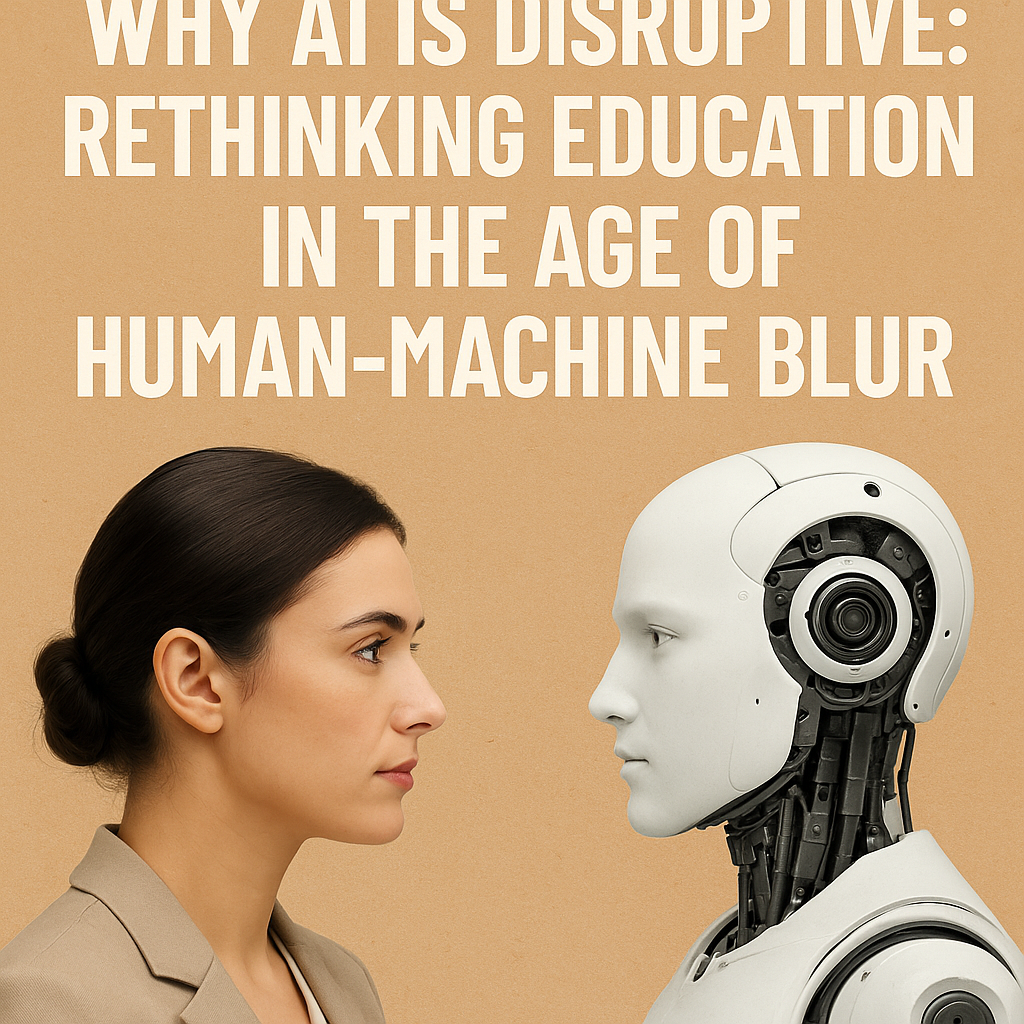
Why AI is Disruptive: Rethinking Education in the Age of Human-Machine Blur

Introduction: The AI Moment Has Arrived

Artificial Intelligence isn’t just a new tool; it’s a force that is reshaping how we think, work, and learn. As philosopher Tobias Rees insightfully puts it, AI is not disruptive because it will outsmart us—it’s disruptive because it dissolves a boundary we once thought was unshakable: the distinction between human and machine. This realization is sending shockwaves through institutions, especially education, where the foundations of knowledge, assessment, and learning are being questioned. We are now in an AI moment—a turning point where urgent questions must be asked and honest answers must follow.

The False Comfort of “Catching Cheaters”

In academia, the response to AI has largely been reactive. Educators scramble to detect AI-generated content in assignments, while developers create tools to outsmart those detectors. This cat-and-mouse game obscures a deeper issue: a system more focused on control than on learning. Are we assessing students to help them grow or just to catch them failing? This obsession with detection technology reveals our reluctance to rethink assessment altogether.

Instead of doubling down on surveillance, this is the time to revisit our purpose. Why do we assess? What do we define as intelligence? Is writing a good essay an indicator of deep thinking, or simply the ability to follow format and logic?

What is Knowledge For? Revisiting Old Questions

AI’s growing presence challenges us to confront foundational questions that have long been sidelined:

  • What is the purpose of knowledge?
  • Why do we create, seek, and share knowledge?
  • Who defines its value?

In many higher education systems, including in Pakistan, these questions are buried under a neoliberal vision. Here, education is equated with “human capital development,” and a student is valued primarily for employability. The success of faculty is often measured by publication count rather than contribution or impact. AI now threatens this mechanistic model because machines can produce “publishable” content faster, cheaper, and possibly more persuasively.

The Neoliberal Model of Education is Being Tested

Pakistan’s HEC Vision 2025 embodies a global trend: treating education as a tool for economic growth. This framework promotes a narrow view of students as future workers and of teachers as content producers. In this system, knowledge is commodified, universities become knowledge factories, and success is measured in data points—grades, publications, employability stats.

But AI disrupts this entire model. If machines can produce data-driven content more efficiently, where does that leave the human in education? If our students are reduced to job-seeking machines and AI outperforms them at those jobs, what’s the point of schooling at all?

A New Educational Paradigm: Humans as Ecosystems

Scholars like Blackie and Luckett offer an alternative vision. They argue that AI’s rise invites us to broaden our understanding of human intelligence. So far, education has prized analytical, linear thinking because it serves the global economy. But this ignores equally essential human faculties: intuition, emotion, imagination.

In this paradigm shift, we must view “humans not as machines, but as ecosystems.” This reframing embraces complexity, relationships, and wholeness. It recognizes that our brains are not detached processors but parts of embodied, context-aware individuals. Knowledge isn’t a static entity to be consumed but something lived and situated in culture, space, and time.

The Myth of Universal Knowledge

AI models are often trained on vast datasets from dominant cultures, reinforcing the myth of universal knowledge. But the idea that one type of reasoning or knowledge is universally valid is both flawed and dangerous. In the age of AI, we need to return to situated knowledge—the idea that every person brings unique perspectives rooted in their context.

This shift also demands that we transcend rigid disciplinary boundaries. Real-world problems aren’t chemistry or sociology problems; they’re human problems. Cross-disciplinary collaboration fosters richer, more adaptable learning environments, better suited to a world in flux.

The Purpose of Education in a Post-AI World

The AI moment should not be co-opted by EdTech companies looking to sell new monitoring tools under the same neoliberal banner. Instead, it should force us to ask: what kind of world are we educating students for?

If education is only about producing efficient workers, AI will inevitably outperform us. But if education is about cultivating humanity—critical thinking, ethical reasoning, empathy, and creativity—then we remain irreplaceable.

This isn’t just about resisting automation. It’s about reclaiming the soul of education.

Conclusion: A Call to Reflect, Not Just React

We are living through a pivotal moment in the history of learning. The arrival of generative AI should not trigger panic or blind adoption but thoughtful reflection. What we do next matters.

We must resist the urge to fall back on outdated systems of control and ranking. Instead, we need to embrace education as a transformative space where knowledge is co-created, not merely delivered. It’s time to view students not as potential cheaters or future workers, but as thinking, feeling, meaning-making humans.

As discussed in our post on “The Future of Learning in the Age of Automation,” the only way forward is to humanize education even more as machines become more capable. Because when the line between human and machine blurs, our humanity becomes the most precious thing we can teach.