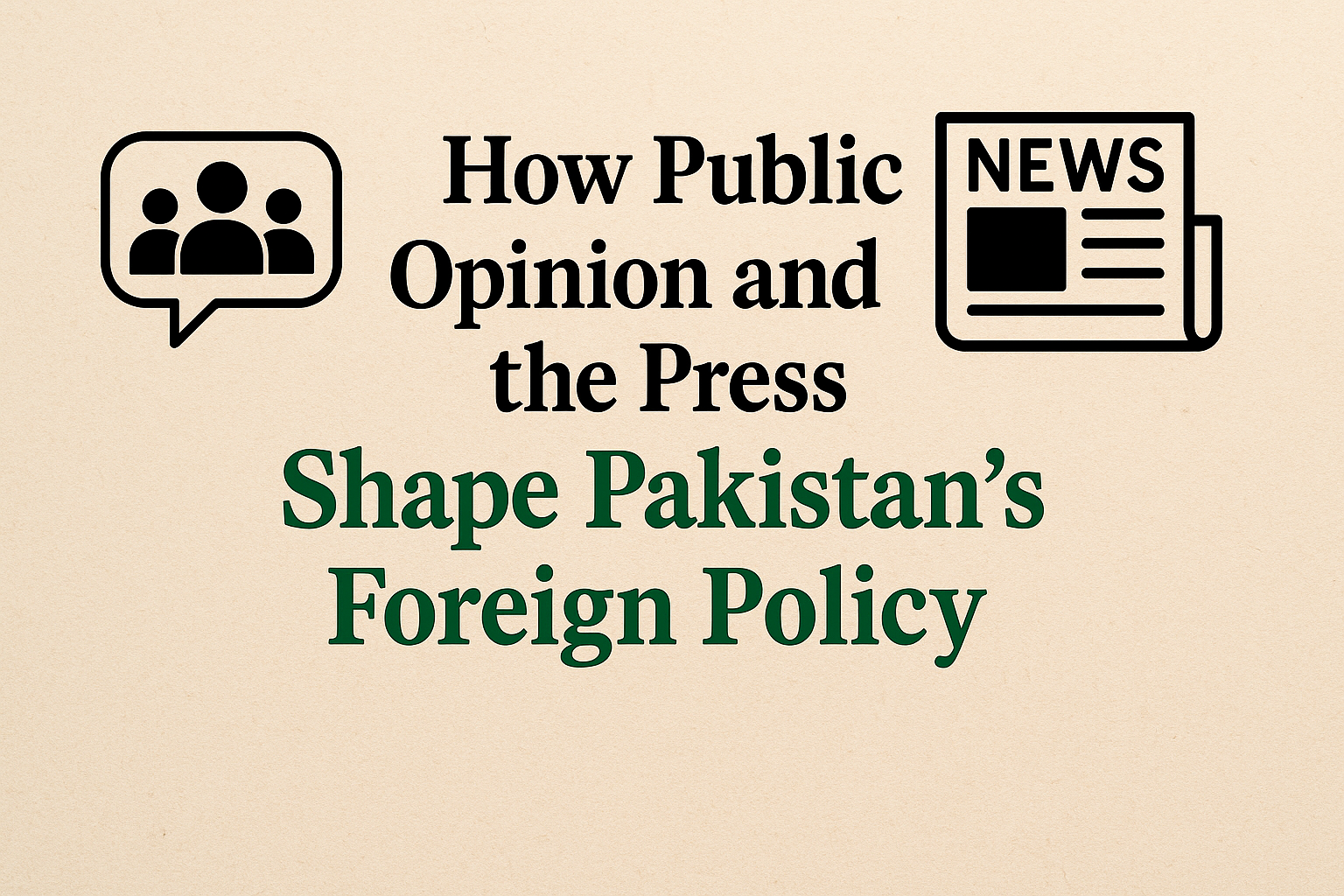
Whether it’s outrage over a drone strike, admiration for a new foreign alliance, or emotional support for a cause abroad, public sentiment matters. And so does the media’s framing of that sentiment. Together, these forces play a growing role in shaping how Pakistan engages with the world.
Foreign policy decisions are often seen as elite-level strategies, crafted behind closed doors by diplomats, generals, and career bureaucrats. But in countries like Pakistan, foreign relations don’t exist in isolation. They’re shaped, pressured, and sometimes redirected by the people—and the press that informs them.
So, how exactly do public opinion and press influence foreign policy in Pakistan? And what does that say about the evolving relationship between democracy, diplomacy, and information?
The Public Voice in Foreign Affairs
It’s easy to think that the average citizen has little to do with international negotiations. After all, what influence could a protester in Lahore have over trade talks with Beijing or border policy with India?
But in reality, public opinion in Pakistan has repeatedly proven to be a quiet force with loud consequences.
Issues like Kashmir, Palestine, the U.S.-Pakistan relationship, and regional ties with Iran or Afghanistan have historically been more than just diplomatic concerns—they’re social touchpoints. They appear in classrooms, mosques, dinner table conversations, and trending hashtags. These aren’t just foreign policy issues; they’re national identity markers.
When the public feels strongly, governments are forced to respond. Often, public pressure leads to symbolic gestures—strong statements in the UN, state-sponsored solidarity events, or diplomatic warnings. Sometimes, it goes further, influencing real policy shifts, halting cooperation, or pushing back against allies.
Kashmir, Palestine, and the Pulse of the People
Two of the clearest examples of this are Pakistan’s policies on Kashmir and Palestine. Both issues have deeply emotional roots in Pakistani society. The media plays them heavily. Political parties reference them constantly. And the public responds—loudly.
When violence escalates in Kashmir or Gaza, social media floods with prayers, anger, and calls for government action. It’s not uncommon to see protests outside embassies, public rallies, or viral campaigns demanding diplomatic retaliation or humanitarian assistance.
These movements don’t just express national solidarity—they compel the government to take action, even when those actions risk international backlash. Public emotion becomes political pressure, and policy is shaped accordingly.
The Role of the Press: Informer, Influencer, Amplifier
In a democratic setting—or even a semi-democratic one like Pakistan—the press becomes the middleman between the state and the public. It doesn’t just report policy; it frames it, questions it, and sometimes reshapes it.
Pakistani media, particularly television news and Urdu-language papers, hold immense power in how the public understands foreign events. How the media frames China’s investment, India’s military moves, or U.S. diplomatic statements directly shapes public opinion—and, by extension, government action.
At times, the press functions as an ally to the state, reinforcing narratives and defending policy decisions. Other times, especially during scandals or crises, it becomes a source of accountability, spotlighting diplomatic failures or missteps.
But it’s not always neutral. Political bias, editorial pressure, and censorship do influence coverage. Sensitive topics—especially those involving powerful allies like China or Saudi Arabia—are often handled with caution. Even so, the media’s overall impact remains undeniable.
Social Media: The New Age Foreign Policy Forum
While mainstream media still holds sway, social media has become a rising force in shaping foreign policy discourse. Twitter storms, viral TikTok videos, and Facebook posts now set the tone for national debates.
Hashtags like #BoycottFrance, #StandWithKashmir, or #FreePalestine have trended across Pakistan, mobilizing thousands—sometimes millions—within hours. These online campaigns often spill into real-world pressure, influencing how politicians frame their statements and what steps ministries take next.
Social media has also amplified diaspora voices. Pakistanis abroad often weigh in on policy with force and visibility, making the state more conscious of how its decisions play not just domestically but globally.
When Policy and Public Pressure Clash
However, public sentiment isn’t always aligned with strategic goals. In fact, one of the biggest challenges in modern diplomacy is managing the gap between what’s popular and what’s practical.
Take U.S.-Pakistan relations. While there’s long-standing public suspicion of American motives, Pakistan continues to cooperate with Washington due to economic, military, and regional security reasons. Balancing this cooperation with public distrust is a diplomatic tightrope—and the press only sharpens that tension.
Similarly, Pakistan’s closeness with China is often celebrated in the media, but criticisms of Chinese labor conditions, local displacements under CPEC, or environmental concerns are muted. Here, press narratives limit public discourse, creating a different kind of policy challenge—one where lack of criticism leads to unchecked decision-making.
Press Freedom and the Foreign Policy Debate
A free press is vital to a well-informed public, and a well-informed public is vital to thoughtful policy. But Pakistan’s press, despite being lively and competitive, still faces barriers when it comes to covering foreign policy honestly.
Military influence, political pressure, and self-censorship mean that not all foreign issues are debated with equal openness. Criticism of certain allies, or of the military’s behind-the-scenes role in diplomacy, often hits a wall.
Despite this, many journalists continue to push boundaries. Investigative reports, sharp op-eds, and alternative media voices are expanding the space for meaningful dialogue. And as the press grows more sophisticated, so does the public it serves.
Conclusion: Democracy’s Foreign Policy Toolkit
Foreign policy in Pakistan is no longer shaped solely in government offices. It’s forged in TV studios, protest rallies, online forums, and newsroom debates. It’s influenced by the passions of the people, and filtered through the power of the press.
While the process is messy, emotional, and sometimes reactive, it’s also proof that foreign relations are not above democracy. They are part of it. And in countries like Pakistan, that democratic influence is only growing.
As the world becomes more connected, and as the Pakistani public becomes more informed, we can expect a more engaged—and more demanding—citizenry. The challenge for policymakers will be to listen to that voice without being overwhelmed by it.
And the responsibility for the press? To make sure that voice is based not just on emotion—but on truth, depth, and perspective.
Written by:
Remedy Talks Editorial Team
Real Issues. Real Conversations. Real Impact.