
Posted on Leave a comment

Pakistan’s Hidden Export: The Shameful Economy of Begging Abroad


By Remedy Talks Editorial Team
When poverty becomes a business model and shame is shipped overseas.


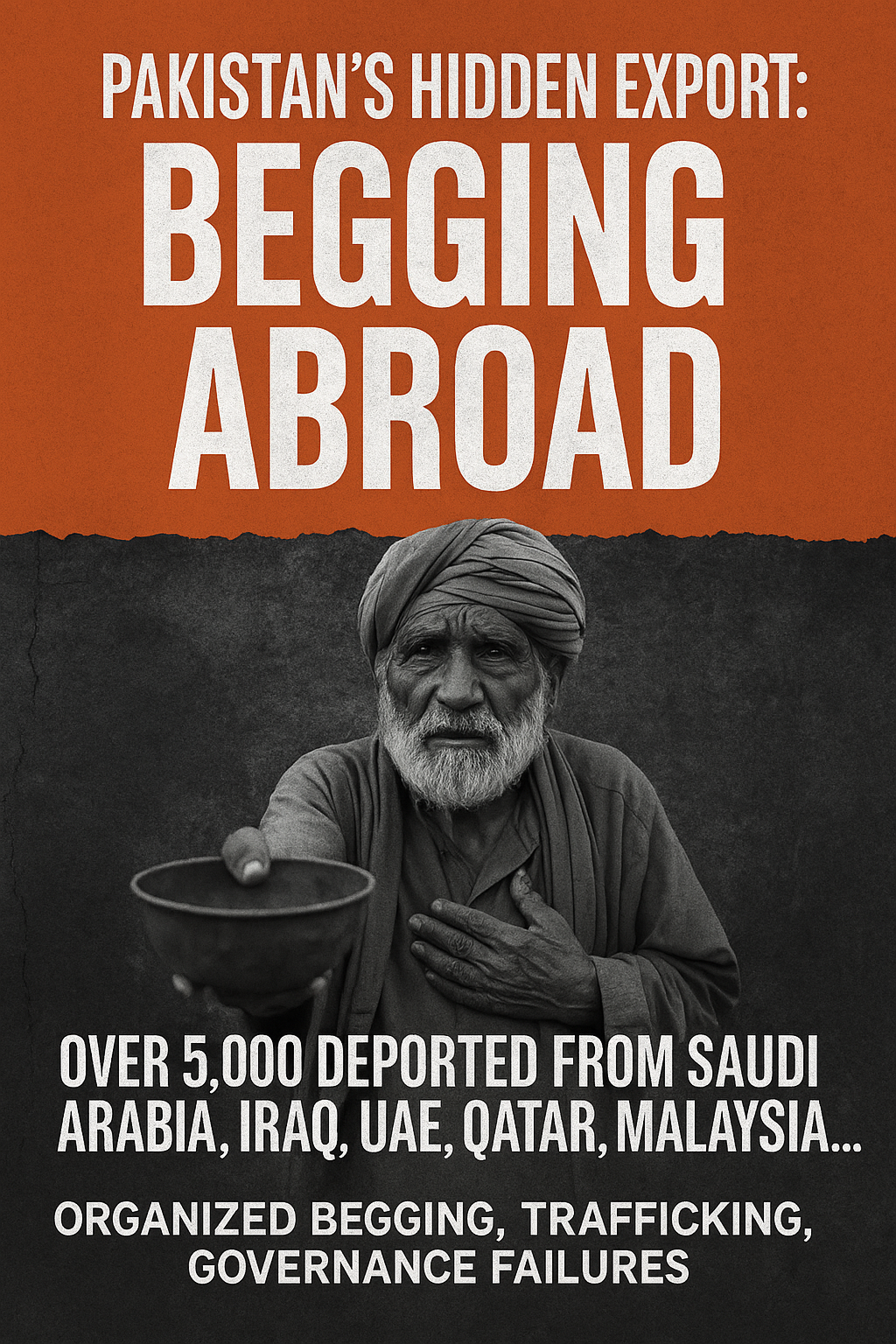
There’s no easy way to say it: Pakistan is now exporting beggars.
Over 5,000 Pakistani nationals have been deported from countries like Saudi Arabia, Iraq, the UAE, Qatar, and Malaysia in just the past 16 months. The revelation came straight from the country’s interior minister—publicly admitted in parliament. What should’ve sparked national outrage has instead been met with silence.

This isn’t just another headline. It’s a damning reflection of how deep poverty, human trafficking, and state neglect have intertwined to form an industry of exploitation—and it’s turning Pakistan into a global embarrassment.


Beyond Poverty: The Rise of the Begging Mafia

Let’s be clear: not every deported person was a desperate soul looking for food or shelter. Many were part of organized begging rings—a full-fledged, cross-border racket that sends individuals abroad under false pretenses, only to exploit them on foreign streets.

And it’s not a small operation either. Reports estimate that this “industry” within Pakistan pulls in billions of rupees annually, operating in broad daylight with the help of trafficking agents, fake visa handlers, and local enablers.

The sad truth? Begging is no longer just a symptom of poverty; it has become a profitable economy—one that thrives on the backs of society’s most vulnerable.


Deportation Stats: The Shame in Numbers

According to official data:

  • 52% of those deported for begging hail from Sindh,
  • followed by Punjab and Khyber Pakhtunkhwa.
  • Thousands are now on the Exit Control List (ECL), banned from traveling abroad.

But let’s not kid ourselves. Adding names to a no-fly list doesn’t address the core issue. That’s like bandaging a bullet wound while ignoring the gunfire.


Who’s Really at Fault?

The begging crisis in Pakistan isn’t just about those holding out their hands—it’s about the systems failing them:

  • Governance breakdown has allowed trafficking rings to operate without fear.
  • Weak employment policies offer no alternatives to those pushed to the margins.
  • Lack of vocational education and rehabilitation programs means there’s no way back for many once they’re on the streets.
  • Charity culture, while noble, is often unregulated—fueling exploitation by rewarding beggars without questioning who’s behind them.

So when foreign governments crack down and publicly shame us by deporting thousands, we have to ask:
Where is our shame at home?


The International Fallout

The diplomatic implications are serious. Countries that once offered Pakistanis employment opportunities are now tightening visa restrictions. This doesn’t just hurt those involved in begging networks—it punishes hardworking migrants, laborers, and professionals who now face suspicion, stigma, and rejection at every border.

Imagine losing the moral and legal standing to defend your citizens abroad—because the world has started associating your passport not with talent or trade, but with organized begging.


The Way Out: Fixing the Root, Not Just the Rot

If the state can track down and detain thousands of undocumented Afghans, it can certainly dismantle domestic trafficking and begging mafias. The question isn’t “how”—it’s whether there’s political will to go beyond surface-level solutions.

Real steps must include:

  • Cracking down on human trafficking networks that facilitate illegal travel for begging.
  • Rehabilitating beggars through job training, microfinance, and skill development, particularly in high-risk regions like Karachi, interior Sindh, and south Punjab.
  • Launching widespread awareness campaigns to expose the exploitation behind “charitable” street begging.
  • Strengthening child protection units to stop the recruitment of children into these criminal operations.
  • Punishing ringleaders with real legal consequences, not just public shaming.

And perhaps most importantly—educating the public. Your loose change might feel like compassion, but it could be fueling an underground economy of abuse.


A National Wake-Up Call

This is not just a story of deportation—it’s a warning sign.
When a nation becomes known for sending its poor to beg abroad, when children are trafficked for sympathy, and when poverty is weaponized as profit—we have lost more than just our international dignity. We’ve lost our moral compass.

There is no quick fix. But ignoring it will only make it worse. Pakistan must recognize that this isn’t just about optics or reputation—it’s about reclaiming human dignity, at home and abroad.


Final Word:
You can’t solve begging with a blacklist.
You can only solve it by giving people a life where they don’t have to beg to survive.

Posted on Leave a comment

From Bounty to Brotherhood: What’s Next for Syria After the U.S Embrace of Ahmed al-Sharaa?


By Remedy Talks Editorial Team
Published on RemedyTalks.com


A Shift in Allegiances That History Won’t Forget

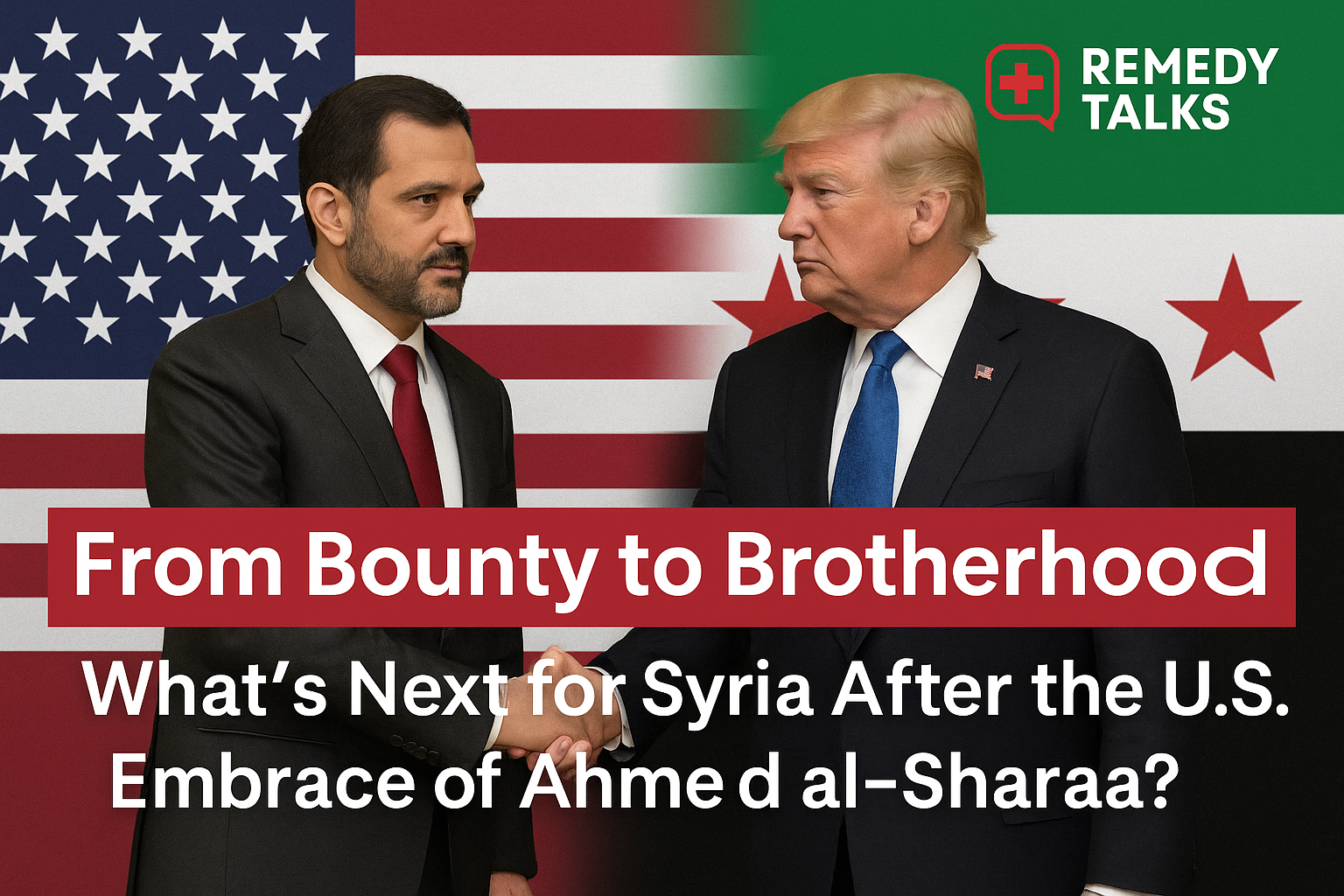
Geopolitics has always been a realm where alliances shift like sand in the wind, but few transformations have been as jarring as the one we just witnessed in Syria. The man once known to the world as Abu Mohammed al-Jolani, feared leader of the Al Qaeda-linked Al Nusra Front, has now stepped onto the global stage with a new identity: Ahmed al-Sharaa, interim leader of Syria—endorsed, welcomed, and legitimized by none other than former U.S. President Donald Trump in a formal meeting in Riyadh.

For Syrians who have endured more than a decade of civil war, displacement, and international isolation, this moment is a complicated one. On the one hand, the lifting of U.S. sanctions signals a potential opening for economic recovery. On the other, it raises deeply uncomfortable questions about morality, memory, and the future of governance in a war-torn nation.


From ‘Terrorist’ to Transitional Leader: A Calculated U-Turn

It wasn’t long ago that the United States placed a $10 million bounty on al-Sharaa’s head. He was then seen as a dangerous militant with ties to extremist ideology. His group, Al Nusra Front, was notorious for its brutal tactics and Islamist agenda.

So what changed?

Nothing about Sharaa’s past did. What shifted was his strategic value in the geopolitical chessboard. He played a crucial role in bringing down the Assad regime, a goal long pursued by the U.S., its European allies, and Gulf states. In doing so, he helped diminish the stronghold of Iranian and Russian influence in the Levant.

His reward? Legitimacy, a handshake, and the promise of reconstruction funding.


A Tale of Two Militants: Syria vs. Afghanistan

The irony is thick when comparing this development to how the world treats the Taliban in Afghanistan. Despite ending a two-decade occupation and taking control of Kabul, the Taliban remain under sanctions and globally isolated.

Ideologically, the Taliban and Sharaa’s previous circle are not dissimilar. But where one challenged Western dominance, the other aligned with it to achieve mutual goals. The message is clear: in the eyes of major powers, militancy is acceptable—if it serves their interests.

This kind of selective political hygiene—where one extremist is rehabilitated and another condemned—does little to build global trust or long-term peace.


The Golan Question and the Price of Recognition

During the Riyadh meeting, President Trump reportedly asked Sharaa to recognize Israel. Yet there was no mention of Israel returning Syrian territory it has occupied for decades, including the strategic Golan Heights.

This puts Syria’s new rulers in a precarious position. Recognition of Israel without territorial restitution could fracture internal unity even further and alienate important regional actors. It might also weaken Sharaa’s domestic legitimacy, especially among nationalists and minority communities already skeptical of his leadership.


Old Fears, New Faces: Will Extremism Simply Change Hands?

The hope—at least on paper—is that this new chapter brings stability and inclusion. Sharaa has spoken of building an “inclusive state.” But early signs are troubling.

Recent reports from within Syria speak of sectarian clashes, especially involving the Alawi and Druze minorities. These communities fear being sidelined or persecuted by a government with deep roots in jihadist ideology.

The risk is that Syria could move from autocracy under Assad to ideological rigidity under Sharaa, replacing one form of oppression with another. The world must avoid being lulled into complacency by the narrative of progress while the reality on the ground deteriorates further.


What Syria Needs — And Deserves

The Syrian people have suffered enough. Over 500,000 lives lost, millions displaced, and an entire generation born into war. What they need now is not another power shift dictated by outside interests but a genuinely inclusive, homegrown process of rebuilding.

That includes:

  • Minority protections, including legal and political safeguards
  • Free and fair elections, not appointments based on militant resumes
  • Economic recovery that lifts communities from poverty, not just elite circles
  • A truth and reconciliation process, to reckon with war crimes on all sides

If these steps aren’t taken, Syria risks falling back into the very cycle of rebellion and repression that tore it apart in the first place.


Looking Ahead: What Future Awaits Syria?

With U.S. sanctions lifted, international investors may begin circling once again. Gulf nations could funnel in aid and contracts. There might even be a diplomatic push to normalize Syria’s relations with the West under its new leadership.

But the path forward will not be smooth. Sharaa’s past will continue to haunt him. Civil society groups, international watchdogs, and disillusioned Syrians will demand accountability, not just economic development.

Syria stands at a crossroads. This could be the beginning of true rehabilitation—if it is led with humility, inclusivity, and a break from past cycles of violence. Or it could simply be a rebranding of authoritarianism, draped in the cloak of international approval.


Final Thoughts

This isn’t just a Syrian story. It’s a cautionary tale of how power works on the global stage—how definitions of “terrorist,” “leader,” and “ally” change not based on morality, but on utility.

The world may have rebranded Ahmed al-Sharaa, but Syrians will judge him not by meetings in Riyadh or endorsements from Washington, but by whether he brings peace, justice, and dignity back to their homes.

And for their sake, the world should hold him to that standard.


Author:
Remedy Talks Team
Truth beyond headlines. Context behind conflict.


Posted on Leave a comment

Ukraine Makes History: Naval Drone Downs Russian Fighter Jet in World-First Military Feat

Introduction

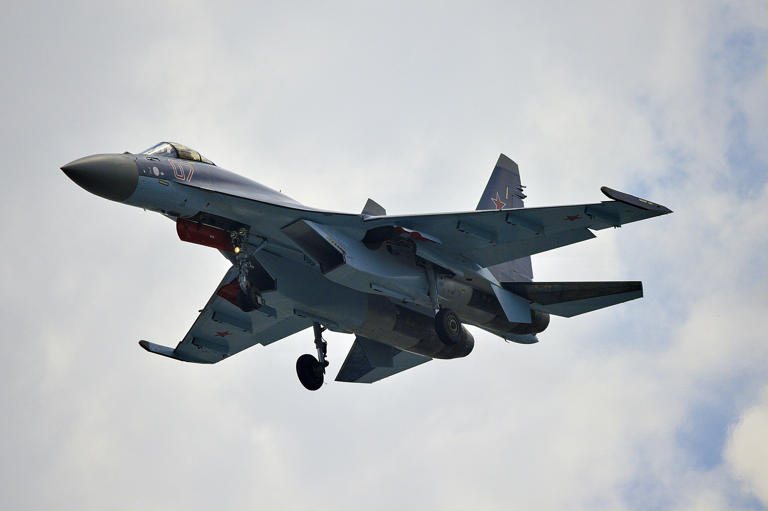
In a groundbreaking development in modern warfare, Ukraine has achieved a historic milestone by using a naval drone to shoot down a Russian Su-30 fighter jet over the Black Sea. This unprecedented event marks the first time a combat aircraft has been destroyed by a maritime drone, showcasing Ukraine’s innovative use of drone technology in its ongoing conflict with Russia.(The Wall Street Journal, New York Post)

The Historic Strike: What Happened?

On May 2, 2025, Ukraine’s military intelligence agency (HUR) reported that a Magura V5 naval drone successfully targeted and destroyed a Russian Su-30 fighter jet near the port city of Novorossiysk. The drone, equipped with an R-73 air-to-air missile, engaged the aircraft, leading to its destruction over the Black Sea. The crew of the Su-30 reportedly survived, being rescued by civilian sailors. (Wikipedia, New York Post)

This operation signifies a significant advancement in Ukraine’s military capabilities, demonstrating the effective integration of unmanned systems in combat scenarios.(Business Insider)

The Technology Behind the Strike: Magura V5 Naval Drone

The Magura V5 is a Ukrainian-developed unmanned surface vehicle (USV) designed for various maritime operations, including reconnaissance and combat missions. In this historic strike, the drone was armed with an R-73 infrared-guided missile, typically used in air-to-air combat. The successful adaptation of this missile for use on a naval drone underscores Ukraine’s innovative approach to modern warfare.(Wikipedia, The Wall Street Journal)

Implications for Modern Warfare

This event marks a significant shift in military tactics, highlighting the increasing role of unmanned systems in combat operations. Key implications include:

  • Cost-Effectiveness: Deploying drones is significantly less expensive than traditional manned missions, allowing for more frequent and flexible operations.
  • Risk Reduction: Unmanned systems eliminate the risk to human pilots, making high-risk missions more feasible.
  • Strategic Advantage: The ability to target and destroy high-value enemy assets with drones can shift the balance in asymmetric warfare scenarios.(Wikipedia)

Ukraine’s Evolving Drone Warfare Strategy

Ukraine has increasingly relied on drone technology to counteract Russia’s military advantages. The successful use of the Magura V5 naval drone to down a fighter jet is part of a broader strategy that includes:(Wikipedia)

  • Naval Drones: Utilizing USVs for reconnaissance and combat missions in the Black Sea.
  • Aerial Drones: Deploying UAVs for surveillance and targeted strikes on enemy positions.
  • Innovation in Armament: Adapting existing missile technology for use on unmanned platforms.

These strategies have allowed Ukraine to effectively challenge Russian forces, despite disparities in traditional military assets.

Global Reactions and Future Outlook

The international community has taken note of Ukraine’s innovative use of drone technology. While Russia has not officially commented on the incident, the successful strike has likely prompted a reassessment of air defense strategies.

Looking forward, Ukraine’s continued development and deployment of unmanned systems may serve as a model for modern military tactics, emphasizing flexibility, innovation, and cost-effectiveness.

Conclusion

Ukraine’s successful use of a naval drone to down a Russian fighter jet represents a significant milestone in military history. This event not only showcases the potential of unmanned systems in combat but also underscores the importance of innovation in modern warfare. As conflicts evolve, the integration of drone technology will likely become increasingly central to military strategy worldwide.(Business Insider)