Posted on Leave a comment

Pakistan’s Hidden Export: The Shameful Economy of Begging Abroad


By Remedy Talks Editorial Team
When poverty becomes a business model and shame is shipped overseas.


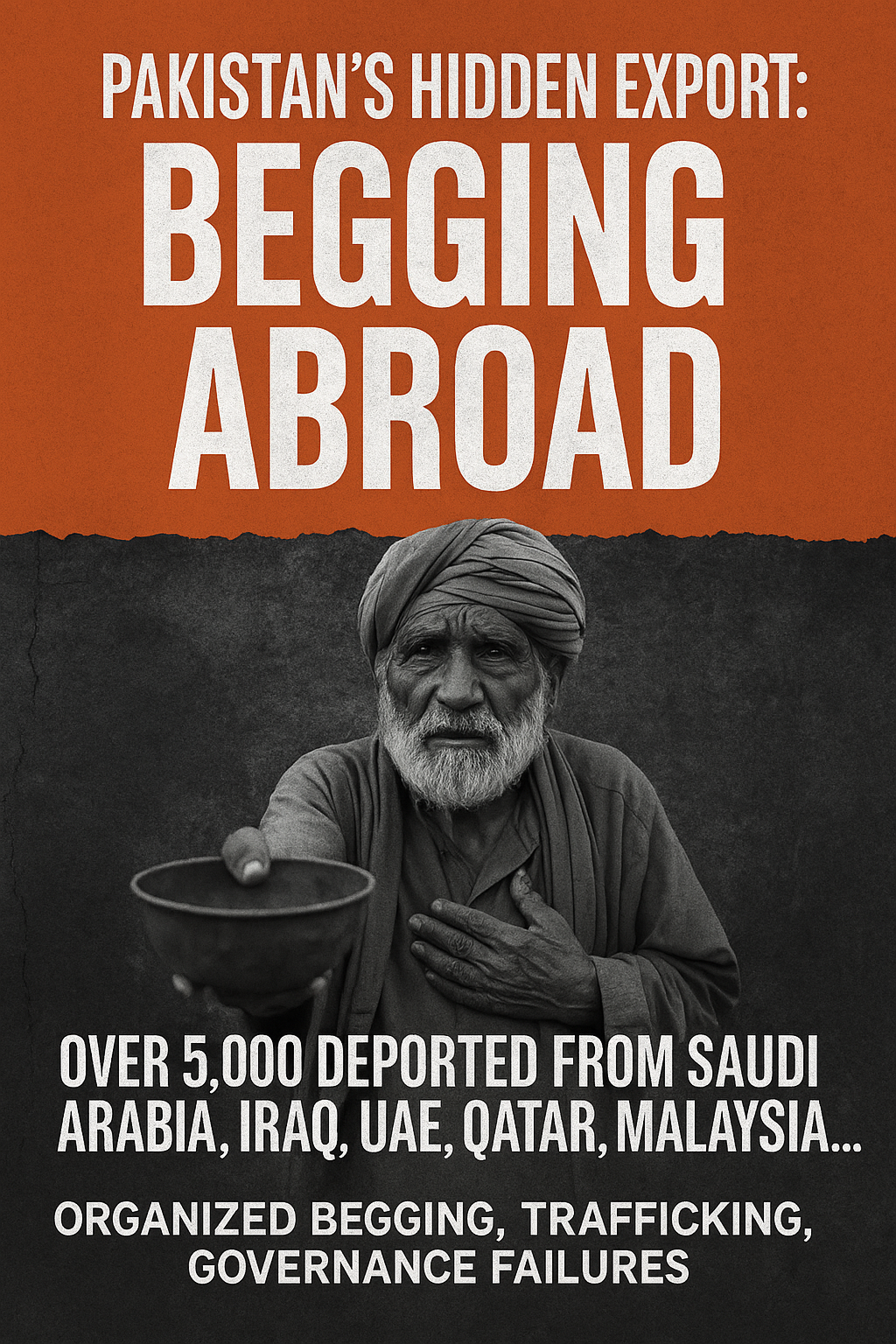
There’s no easy way to say it: Pakistan is now exporting beggars.
Over 5,000 Pakistani nationals have been deported from countries like Saudi Arabia, Iraq, the UAE, Qatar, and Malaysia in just the past 16 months. The revelation came straight from the country’s interior minister—publicly admitted in parliament. What should’ve sparked national outrage has instead been met with silence.

This isn’t just another headline. It’s a damning reflection of how deep poverty, human trafficking, and state neglect have intertwined to form an industry of exploitation—and it’s turning Pakistan into a global embarrassment.


Beyond Poverty: The Rise of the Begging Mafia

Let’s be clear: not every deported person was a desperate soul looking for food or shelter. Many were part of organized begging rings—a full-fledged, cross-border racket that sends individuals abroad under false pretenses, only to exploit them on foreign streets.

And it’s not a small operation either. Reports estimate that this “industry” within Pakistan pulls in billions of rupees annually, operating in broad daylight with the help of trafficking agents, fake visa handlers, and local enablers.

The sad truth? Begging is no longer just a symptom of poverty; it has become a profitable economy—one that thrives on the backs of society’s most vulnerable.


Deportation Stats: The Shame in Numbers

According to official data:

  • 52% of those deported for begging hail from Sindh,
  • followed by Punjab and Khyber Pakhtunkhwa.
  • Thousands are now on the Exit Control List (ECL), banned from traveling abroad.

But let’s not kid ourselves. Adding names to a no-fly list doesn’t address the core issue. That’s like bandaging a bullet wound while ignoring the gunfire.


Who’s Really at Fault?

The begging crisis in Pakistan isn’t just about those holding out their hands—it’s about the systems failing them:

  • Governance breakdown has allowed trafficking rings to operate without fear.
  • Weak employment policies offer no alternatives to those pushed to the margins.
  • Lack of vocational education and rehabilitation programs means there’s no way back for many once they’re on the streets.
  • Charity culture, while noble, is often unregulated—fueling exploitation by rewarding beggars without questioning who’s behind them.

So when foreign governments crack down and publicly shame us by deporting thousands, we have to ask:
Where is our shame at home?


The International Fallout

The diplomatic implications are serious. Countries that once offered Pakistanis employment opportunities are now tightening visa restrictions. This doesn’t just hurt those involved in begging networks—it punishes hardworking migrants, laborers, and professionals who now face suspicion, stigma, and rejection at every border.

Imagine losing the moral and legal standing to defend your citizens abroad—because the world has started associating your passport not with talent or trade, but with organized begging.


The Way Out: Fixing the Root, Not Just the Rot

If the state can track down and detain thousands of undocumented Afghans, it can certainly dismantle domestic trafficking and begging mafias. The question isn’t “how”—it’s whether there’s political will to go beyond surface-level solutions.

Real steps must include:

  • Cracking down on human trafficking networks that facilitate illegal travel for begging.
  • Rehabilitating beggars through job training, microfinance, and skill development, particularly in high-risk regions like Karachi, interior Sindh, and south Punjab.
  • Launching widespread awareness campaigns to expose the exploitation behind “charitable” street begging.
  • Strengthening child protection units to stop the recruitment of children into these criminal operations.
  • Punishing ringleaders with real legal consequences, not just public shaming.

And perhaps most importantly—educating the public. Your loose change might feel like compassion, but it could be fueling an underground economy of abuse.


A National Wake-Up Call

This is not just a story of deportation—it’s a warning sign.
When a nation becomes known for sending its poor to beg abroad, when children are trafficked for sympathy, and when poverty is weaponized as profit—we have lost more than just our international dignity. We’ve lost our moral compass.

There is no quick fix. But ignoring it will only make it worse. Pakistan must recognize that this isn’t just about optics or reputation—it’s about reclaiming human dignity, at home and abroad.


Final Word:
You can’t solve begging with a blacklist.
You can only solve it by giving people a life where they don’t have to beg to survive.
Posted on Leave a comment

Water Wars & Forgotten Promises: Why Pakistan Must Reclaim the Spirit of the 1991 Accord


By Remedy Talks Editorial Team

Water is not just a natural resource in Pakistan—it’s a lifeline. It flows through our farmlands, fuels our economy, and sustains over 240 million lives. Yet, the country’s most essential asset has repeatedly become a source of division rather than unity. The recent debate over the proposed Cholistan canal project once again highlighted the deep-rooted tensions between Sindh and Punjab, forcing the Council of Common Interests (CCI) to intervene.

But this isn’t just about one project. It’s about a pattern of broken agreements, ignored policies, and inequitable practices that have put Pakistan’s water future at risk.


A Crisis That Was Already Written

More than three decades ago, Pakistan’s provinces agreed to a formula to divide river water fairly. Known as the Water Apportionment Accord of 1991, it was supposed to prevent exactly the kind of conflicts we’re seeing today. But that promise was never fully kept.

Instead, what emerged in 2003 was the three-tier formula—an arrangement never legally approved but frequently used by the Indus River System Authority (IRSA). This formula has led to Sindh receiving less water than its rightful share, violating not just the 1991 Accord but also the National Water Policy of 2018.

What’s most troubling? These decisions were made without the consent of all stakeholders, defying the core principle of participatory and consultative water planning set out in the policy itself.


The Disappearing Rights of the Lower Riparian

In water law, the concept of “lower riparian rights” is simple: downstream regions have a legitimate claim to water flow. But in Pakistan, that principle has been quietly eroded.

Sindh’s concerns about upstream diversions—such as the Cholistan project—are not unfounded. History supports them. From the 1945 Sindh-Punjab agreement to the 1991 Accord, the right of the lower riparian has always been acknowledged. Yet today, it is being overridden by administrative shortcuts and unapproved formulas.

The National Water Policy (2018) clearly reaffirms this right. Clause 5.2 states that lower riparian rights must be “scrupulously respected.” But respect means nothing without action.


When Water Disappears Before the Farm

The crisis doesn’t end with unjust sharing. Even the water that is diverted often fails to reach the end-user: the farmer. According to the National Water Policy, out of 104 million acre feet (MAF) of annual canal water, only 58.3 MAF actually reaches the farm gate. The remaining 46.7 MAF is lost—mostly due to seepage from unlined canals.

This is not just inefficiency; it’s an economic disaster.

With growing climate stress, rising demand, and urban expansion, Pakistan cannot afford to waste half of its irrigation water. The policy recommends a nationwide “crash programme” to line water courses and reduce losses by at least a third by 2030.

That goal remains far from reality.


Sea Intrusion: The Silent Killer of Sindh’s Coast

One of the most devastating and overlooked consequences of upstream water diversion is sea intrusion. When less freshwater reaches the Indus Delta, seawater pushes inland, poisoning land and freshwater aquifers.

Clause 8.1.5 of the water policy acknowledges this growing threat. It notes that over 2 million acres of land have already been lost in Thatta, Badin, and Sujawal—devastating local agriculture and displacing communities.

What was once fertile coastline is now a salinated wasteland. Without urgent intervention, this trend could destroy Pakistan’s coastal agriculture and fisheries, pushing thousands into climate-driven poverty.


Environmental Flows Aren’t Optional

Another key but often ignored aspect of water governance is environmental flow—the amount of water that must be left in rivers to maintain their ecology and health. Clause 6.1 of the National Water Policy emphasizes this, stating that environmental flows are essential to conserve river ecosystems, delta morphology, and fisheries.

Yet, in practice, these flows are often sacrificed for irrigation and storage. In doing so, we’re trading short-term gain for long-term collapse.


A Policy That Could Change Everything—If Followed

The National Water Policy of 2018 isn’t just a bureaucratic document. It’s a blueprint for fair and sustainable water management. It includes:

  • Fair distribution based on the 1991 Accord
  • Clear targets for efficiency and conservation
  • Commitments to protect lower riparian rights
  • Goals for improved irrigation methods (“more crop per drop“)
  • Strategic responses to environmental threats

But good policy means nothing without implementation. Unless all provinces—and the federal government—commit to following it in both letter and spirit, Pakistan’s water crises will only deepen.


Why This Matters to Every Pakistani

Water is more than an interprovincial issue. It’s a national survival issue. From the wheat fields of Punjab to the rice paddies of Sindh, from the fishing boats in Sujawal to the tube wells of Balochistan—every region depends on the fair and efficient use of water.

If we continue to politicize water, delay reforms, and ignore environmental limits, we won’t just face droughts and protests. We’ll face food insecurity, economic instability, and mass displacement.

The Council of Common Interests has taken a positive step by emphasizing consensus. But that consensus must be rooted in respecting existing accords, listening to all provinces, and putting long-term sustainability above short-term politics.


Final Thoughts: A Shared Future, A Shared Responsibility

Water doesn’t belong to one province, one government, or one generation. It belongs to all of us—and it belongs to the future.

The National Water Policy already gives us a map. The 1991 Accord already gives us a fair baseline. What’s needed now is political will, transparent governance, and a commitment to collective good.

Pakistan’s future depends on water. And water depends on justice.


Posted on Leave a comment

Peace with Dignity: A Turning Point in South Asia

In a world already burdened with global conflicts and uncertainty, the recent India-Pakistan ceasefire has brought a much-needed pause to escalating military tensions. The standoff, marked by missile strikes and high-alert defence postures, had the region bracing for another crisis. But thanks to a timely US-mediated truce, the situation has cooled — at least for now.

This development, described as “Peace with Dignity,” isn’t just another truce. It signals the possibility of real peace talks in South Asia, a region long plagued by hostility, nationalism, and unresolved disputes.

The Build-Up: India Pakistan Border Tensions

Over the past several weeks, India Pakistan border tensions reached a dangerous peak. Indian forces reportedly launched missile strikes on non-military targets within Pakistan. In retaliation, the Pakistan Air Force response was swift and strategic — hitting military sites across the border with precision.

These actions had analysts deeply worried about another full-scale war between the two nuclear-armed nations.

Military Showdown: J-10C vs Rafale

One of the most notable moments during this escalation was the performance comparison of J-10C vs Rafale fighter jets. The Pakistan Air Force response featured the Chinese-supplied J-10C, a cost-effective and technologically capable aircraft. Surprisingly, it matched up well against India’s more expensive French-made Rafale jets, proving that strategic use of airpower matters more than just budget.

This added a new layer of analysis in global defense discussions, with many rethinking how cost-efficient air dominance can impact warfare.

Diplomatic Breakthrough: US-Mediated Truce

At the peak of rising tension, global powers stepped in. The US-mediated truce, initiated by President Donald Trump with support from Secretary of State Marco Rubio, helped calm the situation. Through back-channel diplomacy and direct talks with both Prime Ministers, the U.S. helped orchestrate an agreement for an immediate ceasefire.

Key points of the truce include:

  • Full and immediate ceasefire
  • Dialogue between India and Pakistan at a neutral location
  • A mutual agreement to avoid further escalation

This development renewed hope in international diplomacy and the ability of powerful mediators to prevent conflict.

Why This Ceasefire Is Different

What sets this India-Pakistan ceasefire apart is its tone and timing. Unlike previous shaky truces, this one opens the door to actual negotiations. Both sides have agreed to engage in peace talks in South Asia to address key issues — including Kashmir, terrorism, water disputes, and border management.

This may be the first meaningful attempt at establishing long-term peace, and possibly normalizing relations between the two arch-rivals.

The Media’s Role and Global Support

Balanced reporting and pressure from the international community — including China, the UK, and the UN — helped steer the conversation away from war and toward dialogue. Responsible media coverage played a vital role in calming panic and encouraging both sides to de-escalate.

Can This Truce Withstand the Test of Time?

Challenges remain. For this ceasefire to evolve into permanent peace:

  • Political leadership must resist populist war rhetoric
  • Future incidents (especially in Kashmir) must be handled through diplomacy
  • Both nations must avoid military posturing in the media

The threat of renewed violence or provocation lingers. However, if both sides stay committed to progress, they can avoid reigniting India Pakistan border tensions.

For the People: What This Means

For millions of people on both sides of the border — especially in Kashmir and border regions — this truce offers more than political victory. It means:

  • Relief from daily fear
  • Continued access to education, healthcare, and markets
  • A chance at cross-border connectivity in the future

Avoiding war means preserving lives, families, and futures. And that’s where the true value of this India-Pakistan ceasefire lies

A New Hope: Peace with Dignity

Peace with Dignity is not just a symbolic phrase — it’s a real opportunity. If sustained, this ceasefire could mark a long-awaited shift from military confrontation to constructive diplomacy.

For long-term peace to become reality, regional leaders must stay committed, media must be responsible, and international allies must support honest dialogue.

The nuclear threat in South Asia is real. But so is the hope for peace — if we nurture it.

Posted on Leave a comment

Pakistan’s Defense Minister Rules Out Immediate Nuclear Option Amid Escalating Tensions with India

Amid escalating military tensions between Pakistan and India, Pakistan’s Defense Minister Khawaja Asif has stated that the nuclear option is “not on the cards right now.” However, he cautioned that if the situation deteriorates further, the consequences could extend beyond the region, potentially affecting global observers. (Ilke News Agency)

Context of Rising Tensions

The recent surge in hostilities was triggered by a deadly attack on Indian tourists in Kashmir in April 2025, which India attributed to Pakistan-based militants. In response, India launched “Operation Sindoor,” targeting alleged terrorist infrastructures within Pakistan. Pakistan retaliated with “Operation Bunyan-ul-Marsoos,” leading to a series of missile and drone exchanges between the two nations. Despite a U.S.-brokered ceasefire announced on May 10, 2025, reports of continued violations from both sides have emerged, casting doubt on the ceasefire’s effectiveness. (The Times, The Guardian)

Pakistan’s Nuclear Doctrine

Pakistan maintains a policy of “full spectrum deterrence,” which does not adhere to a “no first use” stance. This doctrine allows for the potential use of nuclear weapons in response to significant conventional threats. However, Asif’s recent statements indicate that, as of now, there are no plans to convene the National Command Authority, the body responsible for decisions regarding Pakistan’s nuclear arsenal. (Wikipedia, @mathrubhumi)

International Concerns

The international community has expressed deep concern over the escalating conflict between the two nuclear-armed neighbors. Countries including the United States, United Kingdom, Saudi Arabia, and China have urged both nations to exercise restraint and engage in dialogue to prevent further escalation. The potential for a nuclear confrontation has heightened global anxiety, emphasizing the need for immediate de-escalation and sustained diplomatic efforts.

Conclusion

While Pakistan’s Defense Minister has ruled out the immediate use of nuclear weapons, the situation remains volatile. The ongoing military exchanges and mutual accusations underscore the fragility of the current ceasefire. Continued international mediation and a commitment to diplomatic solutions are essential to prevent further deterioration of regional stability. (Ilke News Agency

Posted on Leave a comment

Escalating Tensions Between India and Pakistan: A Looming Crisis in Kashmir

Introduction

In recent weeks, the already fragile relationship between India and Pakistan has deteriorated significantly, following a deadly attack in the Pahalgam region of Indian-administered Kashmir. The incident, which resulted in the deaths of 26 tourists, has reignited longstanding hostilities and raised concerns about the potential for a broader conflict between the two nuclear-armed neighbors.

The Pahalgam Attack and Immediate Aftermath

On April 22, 2025, a group of militants launched a brutal assault in the Pahalgam area, targeting a group of tourists. The attack left 26 people dead, most of whom were Hindu pilgrims, and several others injured. Indian authorities quickly attributed the attack to Pakistan-based militant groups, a claim that Islamabad has vehemently denied.

In response to the attack, India imposed an immediate ban on the import of goods originating from or transiting through Pakistan. This move, aimed at pressuring Pakistan, further strained economic ties that had already been weakened in recent years.

Diplomatic Fallout and Regional Repercussions

The diplomatic fallout was swift and severe. Both countries expelled each other’s diplomats, closed airspace to each other’s airlines, and suspended key treaties, including a vital water-sharing agreement. Pakistan, in turn, halted border trade and warned that any disruption of river flows regulated by the longstanding treaty would be considered an act of war.

Amid these escalating tensions, Pakistan reached out to its Gulf allies, including Saudi Arabia, Kuwait, and the UAE, seeking their support in defusing the situation. Pakistani Prime Minister Shehbaz Sharif emphasized his country’s commitment to regional peace and called on these nations to pressure India towards de-escalation.

Impact on Civilians in Kashmir

The renewed hostilities have had a profound impact on civilians living along the Line of Control (LoC) in Kashmir. In Indian-administered areas, residents are living in fear, with limited access to shelters and emergency services. In Pakistani-administered regions, authorities have allocated emergency funds, closed religious seminaries for safety concerns, and placed emergency services on high alert.

Humanitarian organizations, such as the Pakistan Red Crescent, are mobilizing resources to assist displaced families, preparing tents and aid for those affected by the escalating conflict.

International Concerns and Calls for Restraint

The international community has expressed deep concern over the escalating tensions. India has requested the International Monetary Fund (IMF) to review its loan programs to Pakistan, citing security concerns. Meanwhile, global powers, including the United States, have urged both sides to exercise restraint and emphasized the importance of cooperation in addressing terrorism.

Conclusion

The recent events in Kashmir have brought India and Pakistan to the brink of a potential conflict, with severe implications for regional stability and global security. It is imperative for both nations to engage in constructive dialogue, prioritize diplomacy, and work collaboratively to address the underlying issues fueling this longstanding dispute. The international community must also play a proactive role in facilitating peaceful resolutions and preventing further escalation.