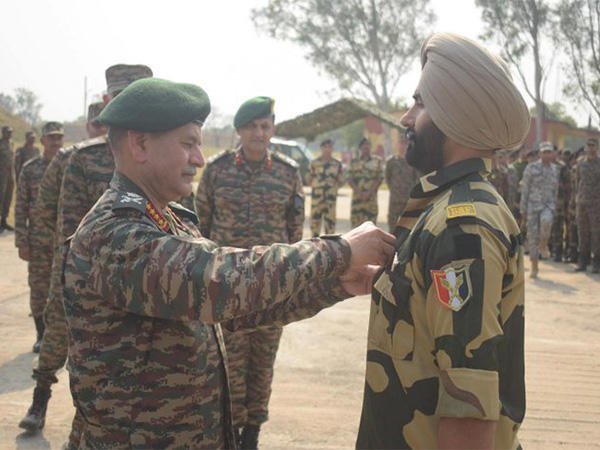
On May 15, 2025, Chief of Army Staff General Upendra Dwivedi honored Constable Harvinder Singh of the Border Security Force (BSF) Jammu with a Commendation Disc for his exceptional diligence during the preparation phase of Operation Sindoor. (SAMBA TIMES)
Operation Sindoor, launched on May 7, 2025, was a decisive military response to the April 22 Pahalgam terror attack, which claimed 26 lives. The operation targeted terrorist infrastructure across Pakistan and Pakistan-occupied Jammu and Kashmir, resulting in the elimination of over 100 terrorists affiliated with groups like Jaish-e-Mohammed, Lashkar-e-Taiba, and Hizbul Mujahideen. (Northeast Live, SAMBA TIMES)
During his visit to forward locations in Baramulla on May 16, General Dwivedi also awarded a Commendation Disc to Head Constable (General Duty) Rantana Ram of the 185 Battalion BSF for his gallant action during the operation. He commended the joint efforts of the Army and BSF personnel for their valor and vigilant actions in dominating the Line of Control (LoC) during Operation Sindoor. (SAMBA TIMES, Northeast Live)
These commendations underscore the critical role of BSF personnel in India’s defense strategy and highlight the successful coordination between the Indian Army and BSF in counter-terrorism operations.(SAMBA TIMES).
Mariam Solaimankhil, a member of Afghanistan’s Parliament in exile, has publicly endorsed India’s Operation Sindoor, characterizing it as a necessary and measured response to terrorism. She asserts that Pakistan has long been a breeding ground for terrorism, with its military and intelligence services, particularly the ISI, supporting extremist groups that have caused significant harm in regions like Kashmir. (News on Air)
In her statements, Solaimankhil emphasized that India’s actions were focused on targeting terrorist camps and military facilities that aid extremist groups. She criticized Pakistan for spreading misinformation and deflecting blame onto other nations, including the United States, while harboring terrorists within its borders. (News on Air, The Tribune)
Solaimankhil also highlighted the internal issues within Pakistan, noting that the country’s support for terrorism has adversely affected its own citizens. She pointed out that regions like Balochistan have suffered from enforced disappearances and human rights violations, leading to declarations of independence by local representatives. (News on Air, The Tribune)
Her remarks align with international perspectives that recognize Operation Sindoor as a decisive military success against terrorism. British political commentator David Vance, for instance, described the operation as “long overdue” and criticized China’s support for Pakistan in this context. (News on Air)
India Issues Stern Warning to Pakistan Amid Escalating Tensions
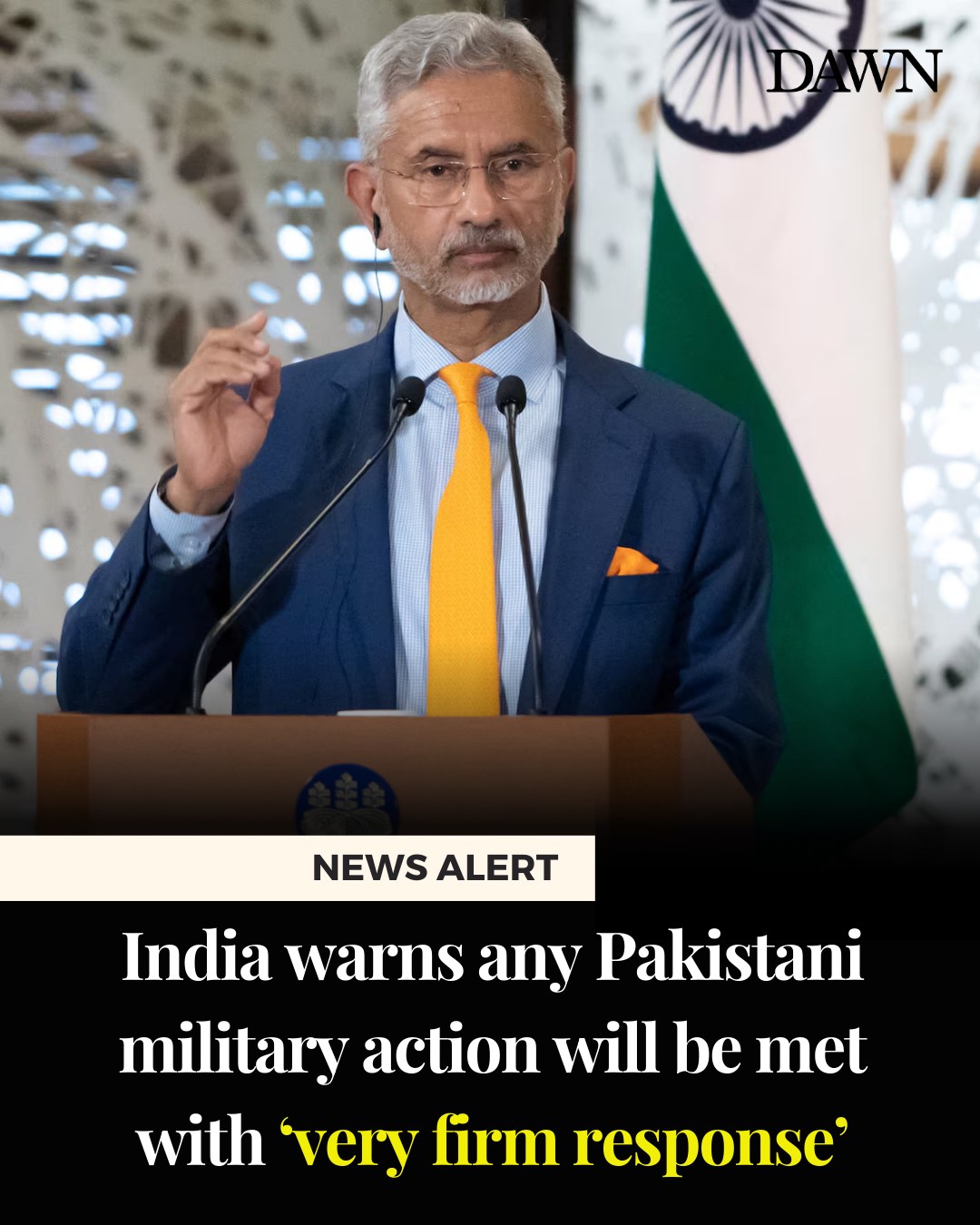
In a significant escalation of regional tensions, Indian Foreign Minister S. Jaishankar has issued a stern warning to Pakistan, asserting that any military aggression will be met with a “very, very firm response.” This declaration follows India’s recent missile strikes on multiple locations within Pakistan, targeting what it describes as terrorist infrastructure.(The Guardian)
Background of the Escalation
On May 6, 2025, India launched “Operation Sindoor,” a series of missile strikes aimed at nine sites in Pakistan and Pakistan-administered Kashmir. These strikes were in retaliation for a deadly terrorist attack on April 22 in Pahalgam, Indian-administered Kashmir, which resulted in the deaths of 26 Hindu tourists. India attributed the attack to Pakistan-based militant groups Jaish-e-Mohammed and Lashkar-e-Taiba.(New York Post, Reuters)
India maintains that the strikes were “targeted and measured,” focusing solely on terrorist camps and avoiding civilian areas. However, Pakistan has contested this claim, reporting that the strikes resulted in at least 31 civilian deaths and 46 injuries, including the destruction of mosques in Bahawalpur and Kotli .(The Guardian)
Pakistan’s Response
In the wake of the strikes, Pakistan has condemned India’s actions as an “act of war.” The Pakistani military claims to have shot down five Indian aircraft and a drone, though India disputes these assertions. Prime Minister Shehbaz Sharif has authorized “corresponding action,” indicating a potential for further military engagement .(The Guardian, Reuters, The Guardian)
Cross-border shelling has intensified along the Line of Control (LoC), leading to additional civilian casualties on both sides. The situation remains volatile, with both nations on high alert.(Reuters)
International Reactions
The international community has expressed deep concern over the escalating conflict between the two nuclear-armed neighbors. The United Nations has called for immediate de-escalation, emphasizing the need for restraint to prevent a larger conflict. U.S. President Donald Trump described the situation as a “shame” and urged both countries to avoid further escalation, offering to mediate if necessary .(The Guardian, Time)
Iranian Foreign Minister Abbas Araghchi is scheduled to meet with Jaishankar in New Delhi, following visits to both countries, in an effort to mediate and reduce tensions .(Malay Mail)
Current Status
As of now, both India and Pakistan have fortified their military positions along the border, with increased troop deployments and heightened surveillance. Airspace restrictions have been implemented, and several international flights have been canceled due to safety concerns. The situation remains tense, with the potential for further escalation if diplomatic efforts fail to yield results.