
Posted on Leave a comment

Trump’s Iran Strike: The End of Diplomacy in the Middle East?

Donald Trump’s military strikes on Iran mark a dangerous shift in U.S. foreign policy. As diplomacy collapses, tensions soar across the Middle East. What happens next?


Trump’s Iran Strike and the Collapse of Diplomacy in the Middle East

Keywords: Trump Iran strike, US-Iran conflict, Middle East tensions, nuclear diplomacy, Iran nuclear sites, UN Charter violation


🔥 A New War in the Middle East?

Despite repeated claims that he would avoid new wars, former U.S. President Donald Trump authorized a military strike on Iran’s nuclear facilities, dragging the United States into a direct confrontation with Iran—alongside Israel.

Targeting Fordow, Natanz, and Isfahan, the joint U.S.-Israeli operation marks a violation of the UN Charter and plunges the Middle East into dangerous new territory.


⚠️ A Historic First: Nuclear States Attack an NPT Member

This is the first time two nuclear-armed states have attacked a non-nuclear NPT member (Iran). Though diplomacy appeared to be in play days before the attack, the airstrikes exposed those talks as a strategic deception.

Trump claimed a decision was “two weeks away,” but his true intent was revealed through his coordinated actions with Israeli forces. In a televised address, he called the strikes a “spectacular success”, boasting that Iran’s nuclear capabilities were “completely obliterated.”


🇮🇷 Iran Responds: Caution, Not Capitulation

Iran’s Foreign Minister Abbas Araghchi condemned the strike, calling it a flagrant violation of international law. While Iran has vowed to continue its nuclear program, it is expected to halt cooperation with the International Atomic Energy Agency (IAEA) and has demanded an emergency UN Security Council meeting.

The UN Secretary-General António Guterres warned that the conflict risks spinning out of control and poses a direct threat to global peace.


⚔️ Strategic Calculations: Will Iran Retaliate?

So far, Iranian officials report limited damage and no civilian casualties, and much of their nuclear material was reportedly moved in advance. Rather than escalating the conflict, Iran may opt for diplomatic and non-kinetic responses, such as:

  • Closing the Strait of Hormuz (triggering global oil price spikes)
  • Cyber or proxy responses
  • International legal action

However, any retaliatory step could provoke further U.S. strikes, something Iran’s leadership seems keen to avoid—at least for now.


🎲 Trump’s Gamble: A Repeat of Iraq?

This is a high-risk foreign policy move for Trump. With no clear exit strategy, the U.S. could face a repeat of the Iraq war quagmire—a scenario involving endless conflict and rising global opposition.

Trump has signaled he will escalate unless Iran fully surrenders its nuclear program—a condition Tehran has firmly rejected.


💣 Diplomacy Betrayed

Perhaps the biggest casualty in this entire crisis is faith in diplomacy.

Despite engaging Iran in negotiations mediated by Oman and the EU, Trump was simultaneously planning and coordinating military operations with Israel. He later admitted to working with Israeli PM Benjamin Netanyahu in an “unmatched partnership.”

Iran’s Foreign Minister bluntly stated:

“Last week, we were in negotiations with the U.S. when Israel decided to blow up that diplomacy. This week, we held talks with the EU when the U.S. decided to blow up that diplomacy.”


🚨 What Happens Next?

If Iran emerges from this crisis intact, it may very well pursue nuclear weapons capabilities—not out of aggression, but survival. This would mark a historic failure of American and Israeli strategy and could trigger a nuclear arms race in the region.


📌 Conclusion: A Turning Point in U.S. Foreign Policy?

Trump’s actions have not only destabilized the Middle East but also eroded global trust in U.S.-led diplomacy. As tensions soar, and alliances fracture, the question remains: Can peace ever return to the region—or has the world entered a new era of nuclear brinkmanship?

Posted on Leave a comment

Trump’s $400M Qatari Jet Gift: A National Security Nightmare or Political Power Play?

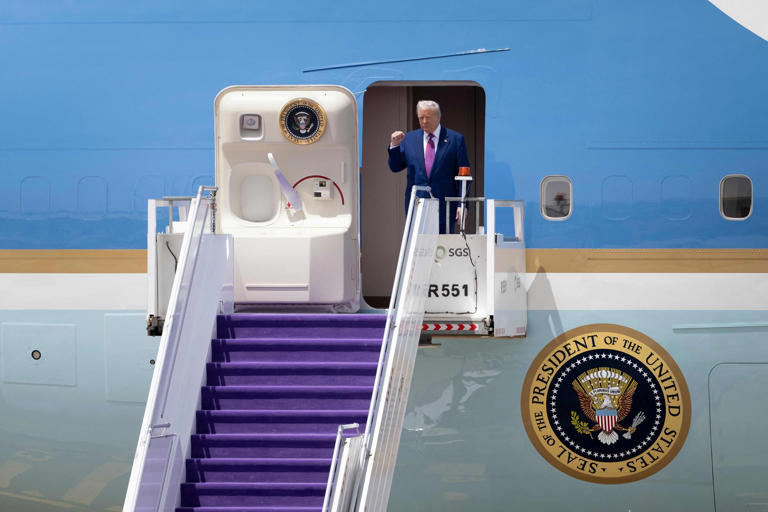
In a move that has ignited a firestorm of controversy, former President Donald Trump has accepted a $400 million luxury Boeing 747-8 jet from the Qatari royal family. Intended to serve as a temporary Air Force One replacement and later as a centerpiece in his presidential library, the gift has raised serious concerns among lawmakers, national security experts, and the public.(Time, Business Insider)

The Gift That Sparked Outrage

The aircraft, originally built by Boeing for Qatar in 2012, boasts opulent features designed by Cabinet Alberto Pinto, including luxurious lounges, bedrooms, and artwork by Alexander Calder. While Trump emphasizes the cost-saving nature of the “free” jet, experts warn that retrofitting the plane to meet U.S. presidential transport standards would require extensive modifications, including secure communications and electronic warfare defenses, potentially costing hundreds of millions of dollars .(Wikipedia, Business Insider

Legal and Ethical Concerns

Senate Minority Leader Chuck Schumer has delayed the confirmation of Trump’s Justice Department nominees, citing concerns over the jet gift’s legality under the Constitution’s emoluments clause, which prohibits federal officials from accepting gifts from foreign governments without congressional approval . Schumer demands transparency regarding potential deals between Qatar and Trump-affiliated interests, including real estate projects in the Middle East.(New York Post)

Attorney General Pam Bondi has deemed the gift legally permissible, asserting that the jet is a donation to the U.S. Department of Defense, not to Trump personally. However, critics argue that the optics of accepting such a lavish gift from a foreign government, especially one previously accused by Trump of funding terrorism, are problematic .(New York Post)

National Security Implications

Security experts express alarm over the potential risks associated with using a foreign-built aircraft as Air Force One. Concerns include the possibility of embedded surveillance equipment, sabotage, or tracking devices that could compromise national security. Retrofitting the jet to meet stringent U.S. security standards would be a complex and costly endeavor, further complicating the situation .(The Daily Beast, Business Insider)

Political Ramifications

Democrats are leveraging the controversy to galvanize voters, portraying the jet gift as emblematic of corruption and foreign influence in Trump’s administration. High-profile Democrats, including Sen. Ed Markey and Rep. Ritchie Torres, have characterized the deal as a major conflict of interest and a form of foreign bribery. Rep. Jamie Raskin plans to introduce a resolution requiring Trump to seek congressional approval under the emoluments clause .(Time)

Even some Republicans, such as Sens. Ted Cruz and Shelley Moore Capito, have expressed concern over the implications of the gift. However, other GOP members dismiss the controversy as political theater, emphasizing the need to replace the aging Air Force One fleet.(Time)

Trump’s Defense

In an interview with Fox News’ Sean Hannity, Trump defended his decision, expressing dissatisfaction with the existing 40-year-old Air Force One and emphasizing that the Qatari jet is a gift to the U.S. Department of Defense, not to him personally. He framed the gesture as a reward for America’s longstanding defense support to Qatar .(The Daily Beast)

Conclusion

The acceptance of a $400 million luxury jet from Qatar by former President Trump has sparked a multifaceted debate encompassing legal, ethical, and national security concerns. As the situation unfolds, it underscores the complexities of foreign relations, the importance of transparency in government dealings, and the challenges of maintaining ethical standards in the highest offices.(Time)

Posted on Leave a comment

Trump’s AI Pope Image: Satire, Shock, and the Power of Digital Provocation

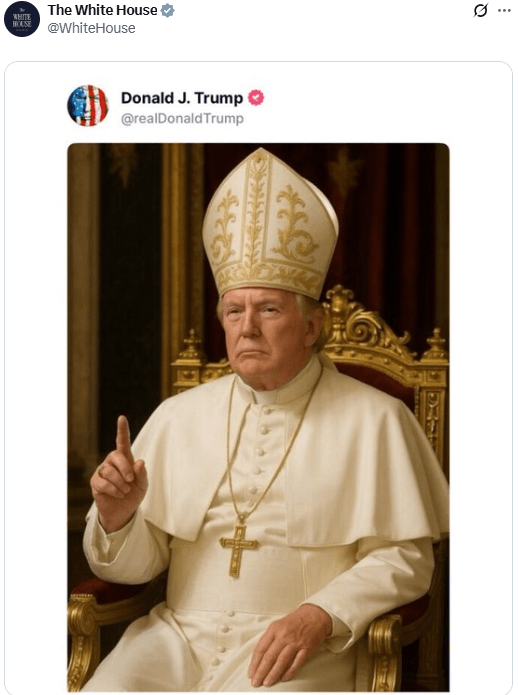
In a move that has sparked both amusement and outrage, U.S. President Donald Trump shared an AI-generated image of himself dressed as the Pope on his Truth Social platform. The image, depicting Trump in full papal regalia, comes shortly after the death of Pope Francis and just days before the Vatican’s conclave to elect a new pontiff.(Business Recorder, tnj.com)

The AI Image: A Digital Provocation

The AI-generated image portrays President Trump in traditional papal attire—white robes, a gold crucifix pendant, and the miter hat—with his right index finger pointed toward the sky. This visual was shared on Truth Social following Trump’s jest to reporters that he would like to be the next Pope, stating, “I’d like to be pope, that would be my number one choice” .(Dawn, Business Recorder)

While some viewed the image as a humorous take, others criticized it as insensitive, given its timing shortly after Pope Francis’s death.

Reactions: Humor Meets Controversy

The image elicited a spectrum of reactions:(tnj.com)

  • Supporters’ Perspective: Some of Trump’s supporters found the image amusing, interpreting it as a satirical jab at political correctness and the establishment.(tnj.com)
  • Critics’ Viewpoint: Many religious leaders and commentators condemned the image as disrespectful. The Network Journal reported that religious groups accused Trump of mocking the sanctity of the papacy, labeling the image as “tone-deaf” and “inappropriate” .(tnj.com)

Senator Lindsey Graham added to the discourse by humorously suggesting that the conclave should “keep an open mind” about considering Trump as the next Pope .(New York Post)

The Intersection of AI, Politics, and Religion

This incident underscores the growing influence of AI-generated content in political discourse. The use of AI to create satirical images blurs the lines between humor and offense, especially when intersecting with sensitive topics like religion.(Business Recorder)

The controversy also highlights the challenges of navigating digital expression in an era where AI tools can produce highly realistic images, raising questions about authenticity, intent, and impact.

Conclusion: A Reflection on Digital Expression

President Trump’s AI-generated papal image serves as a case study in the complexities of digital expression in contemporary politics. While intended as satire, the image’s reception reveals deep divides in public perception and the potent influence of AI in shaping political narratives.

As technology continues to evolve, society must grapple with the ethical considerations of AI-generated content, especially when it intersects with deeply held beliefs and institutions.